
Choose how you want to
use
FlashAlpha.
billed annually ($2,868/yr)
- 2,500 requests/day
- 15-second freshness - near-live data
- Full-chain GEX (docs) - all expirations aggregated
- 0DTE analytics (docs) - pin risk, expected move, gamma regime
- Flow Analytics (docs) - simulation-aware GEX/DEX/levels/pin-risk/dealer-risk recomputed on intraday effective OI
- Options chain (docs) with full Greeks & IV
- Volatility analytics (docs) - realized vol, skew, term structure
- AI narrative (docs) - verbal exposure analysis
- Kelly criterion position sizing
- Extended Market Overview - full-chain exposure, VRP, term structure, advanced vol sections
- Live Screener (docs) - 20-symbol Tier 1 universe, filter trees, cascading expiry/strike/contract filters
- Priority email support
billed annually ($14,388/yr)
- Everything in Growth
- Unlimited requests - no daily cap
- Live Screener (full) (docs) - ~250 symbols, formulas, strategy scores (harvest, dealer-flow-risk, iron-condor)
- Backtest to the minute since 2017 (Historical API) - replay GEX, VRP, dealer regime & max pain at any minute; no lookahead; same response shape as live
- VRP analytics (docs) - z-score, regime, strategy scores, directional decomposition
- SVI vol surfaces (docs) - calibrated parameters, arbitrage detection, variance swaps
- Higher-order Greeks (docs) - vanna, charm, volga, speed surfaces
- No cache - real-time data, fresh on every request
-
SVI-smoothed IV on every option quote (
svi_vol) -
OI simulator state + Flow bundle (docs) - unclamped simulated OI, effective OI per contract, one-call
/v1/flow/live -
Flow polarity (guide) -
?polarity=flowsigns GEX & levels by the session dealer-inventory change from the tape (structural vs flow) - Unusual flow signals (docs) - scored sweep/block feed with NBBO aggressor, opening bias, intent + watchlist tilt roll-up
- Raw Flow Data tape (docs) - per-symbol option/stock trades, blocks, minute history, cross-symbol leaderboards & outliers
- 99.9% uptime SLA
billed annually ($756/yr)
- Everything in Free
- 250 requests/day
- 15-second freshness - near-live data
- ETFs & index symbols (SPY, QQQ, IWM, SPX, VIX, RUT...)
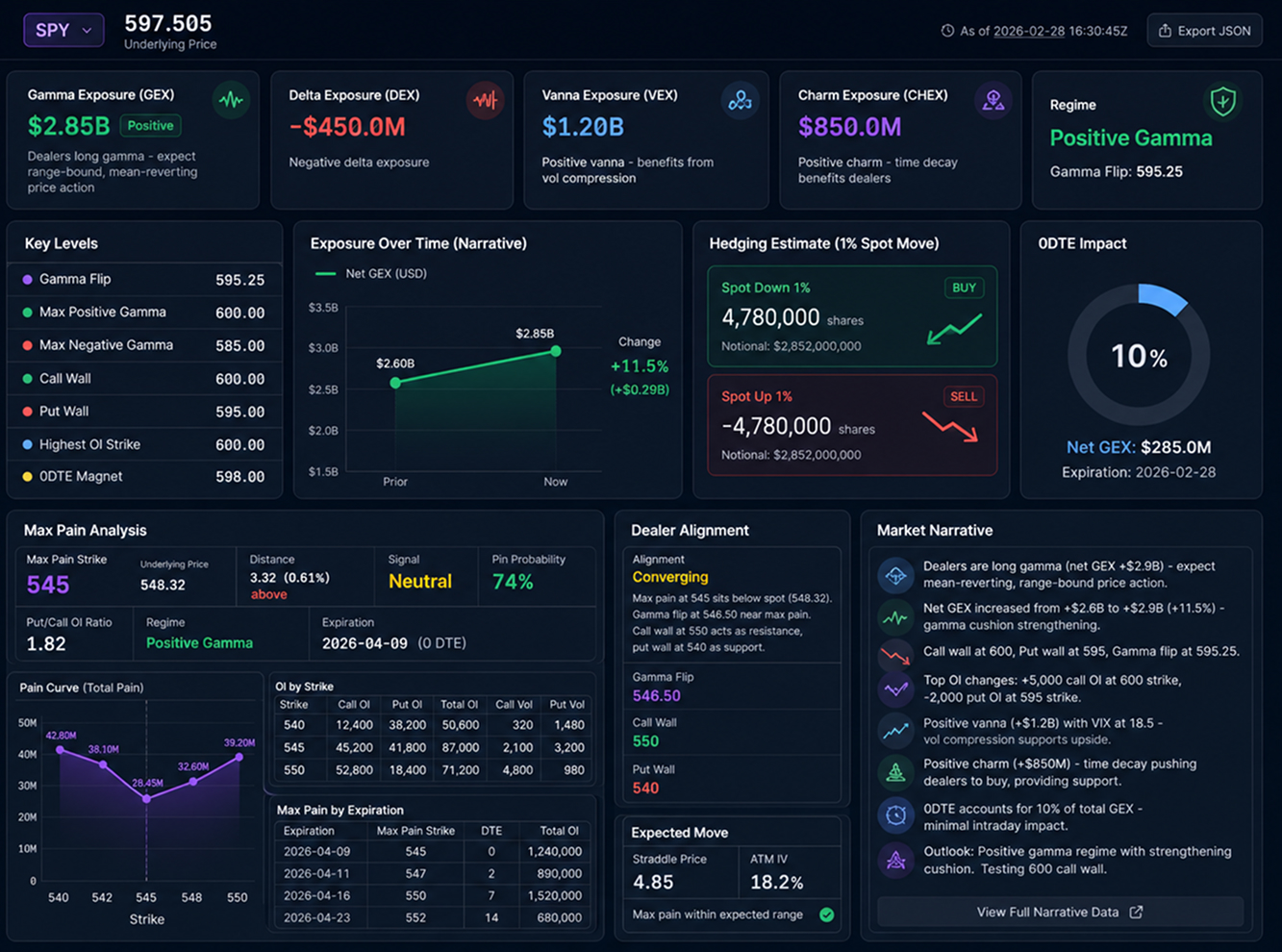
- DEX, VEX, CHEX (docs) - delta, vanna, charm exposure
- Max pain analysis (docs) - pain curve, pin probability, dealer alignment
- Market Overview - daily multi-section dealer positioning, vol & skew analysis
- Email support
- Official SDKs (Python, JS, C#, Go, Java)
What FlashAlpha offers
Skip the surface-engineering: wing-bounded SVI fits with arbitrage flags, variance-surface and var-swap calculations, higher-order greek surfaces and arb detection arrive ready to trade.
curl -H "X-Api-Key: YOUR_KEY" \
  "https://lab.flashalpha.com/v1/adv_volatility/SPX"
{
  "symbol": "SPX",
  "svi_params": { "a": 0.04, "b": 0.12, "rho": -0.62, "m": 0.01, "sigma": 0.18 },
  "arb_free": true,
  "var_swap_strike": 17.9
}
1. Grab your API key
Sign up free, no card. Your key works on every endpoint instantly.
2. Call the endpoint
One GET request per ticker returns computed analytics, no rebuilding greeks or exposure yourself.
3. Wire it in
Drop it into your dashboard, model or backtest. Live and historical share one response shape.
Build your first options analytics dashboard in minutes
5 requests / day
2,500 requests / day
Use with your AI via MCP
Connect FlashAlpha to your favorite AI tools in one click.
Learn more about MCPOne-click MCP setup
Works with any MCP client
Frequently Asked Questions
Everything you need to know before using the API.
Q
What does the advanced volatility endpoint return?
SVI surface parameters, the variance surface, arbitrage detection, higher-order greek surfaces and a variance-swap strike, the building blocks for relative-value vol trades.
Q
Are the surfaces arbitrage-free?
Yes, fits are calendar- and butterfly-checked, and the response flags arbitrage so you don't trade off a bad surface.
Q
What's the difference between variance and volatility risk premium?
Variance risk premium is priced on variance (squared vol), volatility risk premium on vol itself; they diverge in the tails, which the guide above explains and the data lets you trade.
Q
Can I get historical surfaces for backtesting?
Yes, the surface and advanced-volatility endpoints replay historically, so dispersion and RV strategies can be backtested point-in-time.
Alpha
billed annually ($14,388/yr)
Alpha unlocks SVI surfaces, variance/var-swap analytics, VRP and the historical surface, the full relative-value toolkit.
- SVI parameters + arbitrage-checked surfaces - research-grade smiles, not raw quotes
- Variance surface + var-swap strikes per expiry
- VRP suite and dispersion - implied correlation per basket in one call
- Historical surfaces - relative-value backtests point-in-time since 2017
Growth reads vol live - IV-RV spreads, term structure - and runs daily workflows well. SVI surfaces, var-swap strikes, dispersion and replay are Alpha.
Compare All Plans