
Choose how you want to
use
FlashAlpha.
billed annually ($2,868/yr)
- 2,500 requests/day
- 15-second freshness - near-live data
- Full-chain GEX (docs) - all expirations aggregated
- 0DTE analytics (docs) - pin risk, expected move, gamma regime
- Flow Analytics (docs) - simulation-aware GEX/DEX/levels/pin-risk/dealer-risk recomputed on intraday effective OI
- Options chain (docs) with full Greeks & IV
- Volatility analytics (docs) - realized vol, skew, term structure
- AI narrative (docs) - verbal exposure analysis
- Kelly criterion position sizing
- Extended Market Overview - full-chain exposure, VRP, term structure, advanced vol sections
- Live Screener (docs) - 20-symbol Tier 1 universe, filter trees, cascading expiry/strike/contract filters
- Priority email support
billed annually ($14,388/yr)
- Everything in Growth
- Unlimited requests - no daily cap
- Live Screener (full) (docs) - ~250 symbols, formulas, strategy scores (harvest, dealer-flow-risk, iron-condor)
- Backtest to the minute since 2017 (Historical API) - replay GEX, VRP, dealer regime & max pain at any minute; no lookahead; same response shape as live
- VRP analytics (docs) - z-score, regime, strategy scores, directional decomposition
- SVI vol surfaces (docs) - calibrated parameters, arbitrage detection, variance swaps
- Higher-order Greeks (docs) - vanna, charm, volga, speed surfaces
- No cache - real-time data, fresh on every request
-
SVI-smoothed IV on every option quote (
svi_vol) -
OI simulator state + Flow bundle (docs) - unclamped simulated OI, effective OI per contract, one-call
/v1/flow/live -
Flow polarity (guide) -
?polarity=flowsigns GEX & levels by the session dealer-inventory change from the tape (structural vs flow) - Unusual flow signals (docs) - scored sweep/block feed with NBBO aggressor, opening bias, intent + watchlist tilt roll-up
- Raw Flow Data tape (docs) - per-symbol option/stock trades, blocks, minute history, cross-symbol leaderboards & outliers
- 99.9% uptime SLA
billed annually ($756/yr)
- Everything in Free
- 250 requests/day
- 15-second freshness - near-live data
- ETFs & index symbols (SPY, QQQ, IWM, SPX, VIX, RUT...)
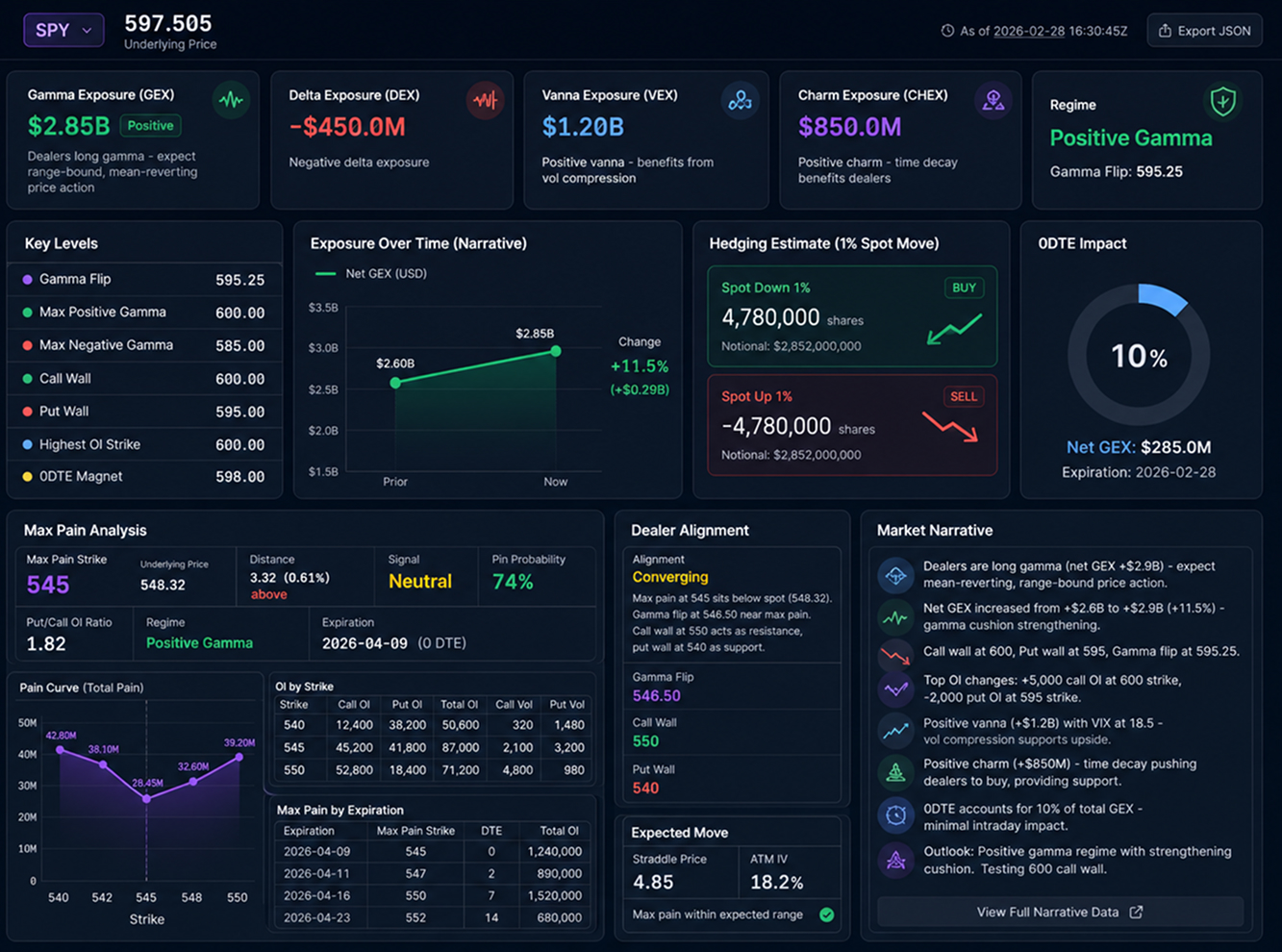
- DEX, VEX, CHEX (docs) - delta, vanna, charm exposure
- Max pain analysis (docs) - pain curve, pin probability, dealer alignment
- Market Overview - daily multi-section dealer positioning, vol & skew analysis
- Email support
- Official SDKs (Python, JS, C#, Go, Java)
What FlashAlpha offers
Quantify the edge before you sell: VRP measures implied minus realized, z-scored and percentile-ranked so you know when premium is statistically rich, not just when IV looks high.
curl -H "X-Api-Key: YOUR_KEY" \
  "https://lab.flashalpha.com/v1/vrp/AAPL"
{
  "symbol": "AAPL",
  "vrp": 3.4,
  "vrp_zscore": 1.8,
  "vrp_percentile": 86,
  "regime": "rich",
  "suggested": "premium-selling favored"
}
Why Growth is the better choice
Near Real-Time Data
15-second updates keep your strategies in sync with the market.
Full Market Structure
Access complete options chain analytics including Full GEX, DEX and Max Pain.
Institutional Analytics
Flow Analytics, Volatility Analytics and AI-powered market narratives.
Broader Market Coverage
Trade stocks, ETFs, indexes and futures from one API.
Built for Automation
2,500 daily requests with official SDKs for production applications.
Designed to Scale
From personal dashboards to trading systems without hitting Free plan limits.
Sell premium when volatility is genuinely rich, and stand down when it isn't.
1. Grab your API key
Sign up free, no card. Your key works on every endpoint instantly.
2. Call the endpoint
One GET request per ticker returns computed analytics, no rebuilding greeks or exposure yourself.
3. Wire it in
Drop it into your dashboard, model or backtest. Live and historical share one response shape.
Build your first options analytics dashboard in minutes
5 requests / day
2,500 requests / day
Use with your AI via MCP
Connect FlashAlpha to your favorite AI tools in one click.
Learn more about MCPOne-click MCP setup
Works with any MCP client
Frequently Asked Questions
Everything you need to know before using the API.
Q
What is VRP and why z-score it?
Volatility risk premium is implied vol minus realized vol, the edge a seller harvests. Z-scoring and percentile-ranking it against history tells you whether today's premium is actually rich, not just high.
Q
IV rank vs IV percentile, which should I use?
IV rank scales today's IV between its 52-week high and low; IV percentile is the share of days below today. Percentile is more robust to outliers; the guide above covers when each matters.
Q
Which plan has VRP analytics?
The full volatility profile (IV-RV spreads, skew, term structure) is Growth; the VRP dashboard (z-score, percentile, directional VRP, regime) and historical VRP percentiles are Alpha.
Q
Does VRP work on single names or just the index?
Both, and single-name VRP behaves very differently around earnings than index VRP, which is exactly when sizing matters most.
Growth
billed annually ($2,868/yr)
The premium seller's toolkit: full volatility profile, term structure, expected move and the earnings calendar - sell rich vol, stand down on cheap vol.
- IV-RV spread, live - sell rich vol, stand down on cheap vol
- Full volatility profile - term structure and realized-vs-implied context
- Earnings calendar + expected move - never short a jump you did not price
- VIX regime state - the macro gate on every entry
When Alpha instead: VRP z-scores and percentiles tell you the premium is statistically rich - not just high - and the no-lookahead VRP history lets you backtest the rule.
Compare All Plans