Help us double down on what's working, instead of guessing. Takes 5 seconds, totally optional.
Market Overview
Data-driven market structure analysis powered by lab.flashalpha.com - volatility, dealer positioning, and regime assessment across the index complex, refreshed multiple times per trading day. Every number is pulled straight from our API endpoints by deterministic code.
FlashAlpha ResearchAI-assisted
Generated
Validated citations - no literal numbers from LLM
You're reading yesterday's market analysis
Basic unlocks today's post-open analysis (9:45 ET).
Growth unlocks all 3 daily refreshes (open, midday, close) plus actionable trade ideas and “What it means for your trading”.
Growth unlocks the full trading day: midday (12:30 ET) + close wrap (4:15 ET), actionable trade ideas per section, and “What it means for your trading” analysis.
SPY at 760.13 is trading directly at the put wall 760.00 with net GEX -$8.9B - dealers short gamma, moves get amplified rather than absorbed. Call wall 765.00 caps upside; gamma flip 766.36 sits just above spot, so any reclaim shifts dealers from selling weakness to buying strength. Vanna -$94.49B and charm -$6.4M both lean negative - a vol spike compounds selling and time decay pressures dealers into the close. VIX at 16.85 with VIX3M 19.21 keeps the curve in Contango, so front vol sellers still get paid the carry. ATM IV 13.71% against HV20 8.69 prints VRP 5.02% - options are rich to what price has actually delivered. VVIX at 94.72 keeps vol-of-vol Normal, so no jump-risk premium tax on sizing. Bottom line: iron condors around 765.00/760.00 at 30-45 DTE, watch 766.36 as the regime pivot, avoid naked short puts while spot lives below flip.
Negative gamma across SPY/QQQ/IWM at spot, Elevated / Watchful regime - moves amplified below flip
SPY at 760.13 is pinned right on the put wall 760.00 with dealers short gamma at -$8.9B - amplification, not dampening, defines this tape. VIX term structure holds Contango and VRP stays rich at 5.02%, keeping short-vol carry alive despite the negative-gamma backdrop. The setup rewards defined-risk vol sellers at 30-45 DTE, but a break of gamma flip 766.36 flips the script.
Dealer positioning levels
Symbol
Spot
Gamma flip
vs Flip
Call wall
Put wall
Max pain
Net GEX
Regime
SPY
760.13
766.36
-0.81%
765
760
755
-$8.90B
Short gamma
QQQ
710.33
715.77
-0.76%
720
700
705
-$2.60B
Short gamma
IWM
286.45
294.60
-2.77%
290
285
290
-$5.83B
Short gamma
VIX
16.85
18
-6.38%
20
16
19
-$24.46M
-
Spot below the gamma flip means dealers are short gamma and hedge with the move, which amplifies range. Above it they hedge against the move, which dampens it.
Volatility and risk premium
Symbol
ATM IV
HV 20d
VRP
25d skew
P/C OI
P/C volume
SPY
13.71
8.69
+5.02
4.30
2.61
1.07
QQQ
17.95
12.16
+5.79
4.74
1.45
1.46
IWM
19.59
12.60
+6.99
4.75
2.58
1.52
VIX
75.13
92.18
-17.05
-102.33
0.34
0.38
VRP is implied minus realised volatility. Positive means options are pricing more movement than has actually occurred, which favours sellers.
Volatility complex
Measure
Value
Change
VIX
16.85
-2.03%
VVIX
94.72
-0.18%
SPX
7,612.82
+0.36%
SKEW index
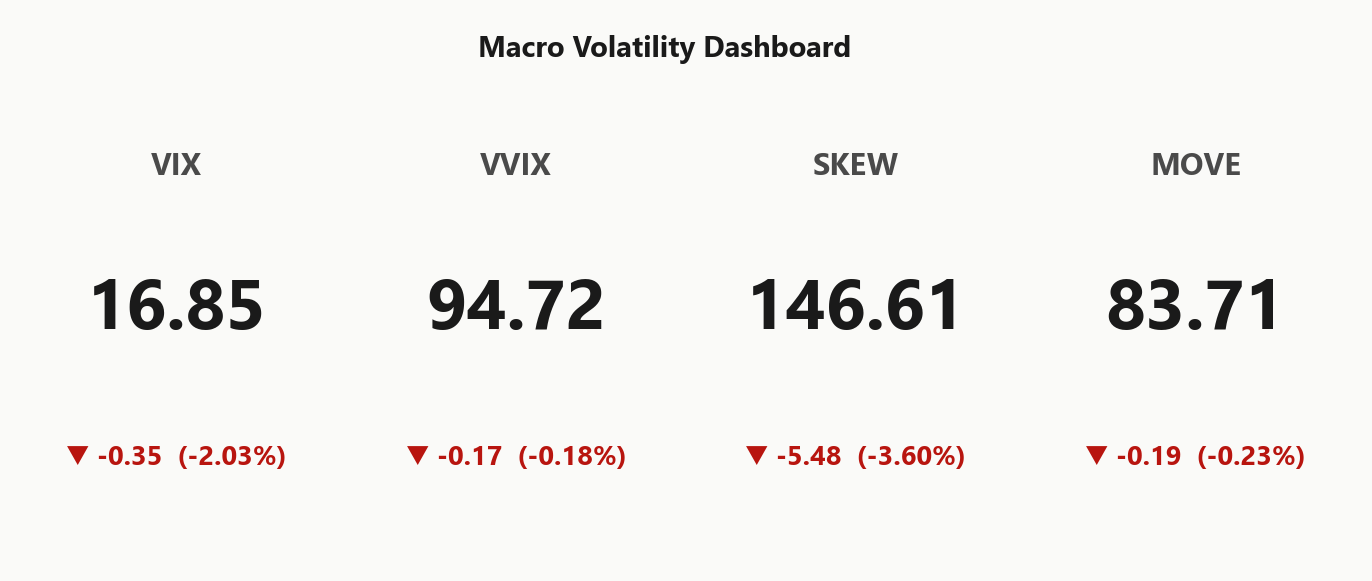
146.61
-3.60%
MOVE (bond vol)
83.71
-0.23%
VIX term (9d/30d/3m/6m)
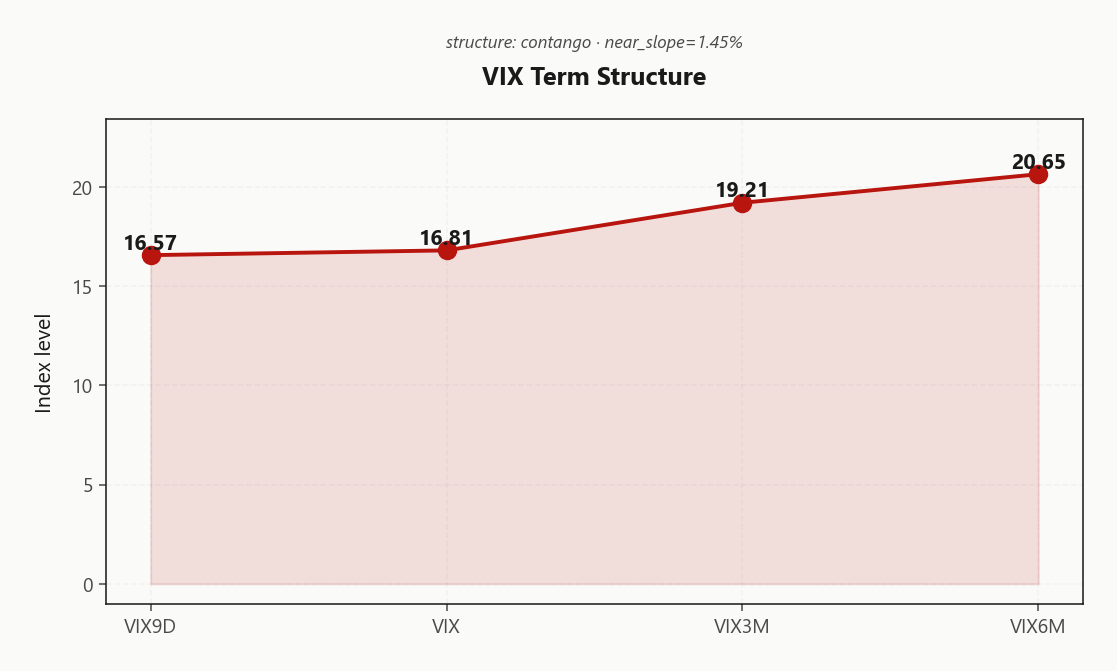
16.57 / 16.81 / 19.21 / 20.65
Steep contango
VVIX / VIX
5.62
Normal
Regime
Elevated / Watchful
Regime Assessment
Current regime reads Elevated / Watchful with VIX anchored at 16.85 - vol sellers are active but not overextended, and the transition matrix is telling you this state persists rather than resolves. Half-life prints 15 sessions, so position sizing should be calibrated for a regime that stays put, not one about to flip.
Probability of a panic transition over the next five sessions sits at 0.05 - negligible. The market isn't pricing a break, and cross-asset tone confirms it: MOVE contained, VVIX normal, term structure in Contango. No hidden stress signal to override the base case.
The real risk to the carry trade is the other direction: probability of dropping into a low-vol regime over ten sessions is 0.45. That's a meaningful compression risk - VRP tightens, iron condors stop paying, and the systematic short-vol crowd rushes the same exit. Stay sized for persistence, but don't overstay if the regime label shifts toward low.
What it means for your trading
Regime is Elevated / Watchful and sticky with half-life 15 sessions - panic tail is remote, but a drift into low-vol carries real odds and would compress the premium that funds today's structures.
Trading readVIX, VVIX, SKEW, MOVE all reading contained and internally consistent - no cross-asset divergence to flag as a hidden stress signal. When these agree, the regime persists.VIX = equity vol. VVIX = vol of vol (is the fear gauge itself being stressed?). SKEW = cost of tail hedges vs ATM. MOVE = bond vol. Divergences between them (e.g. calm VIX but elevated VVIX) often precede regime shifts.
Forward Vol Geometry
Front curve holds Contango with VIX9D at 16.57 sitting under VIX 16.81 - no near-term stress bid, no event premium being paid up in the front. The tape is telling you the crowd sees no catalyst inside the next two weeks.
Push out the curve and the belly gets interesting: VIX3M 19.21 against VIX6M 20.65 means forward vol between 60-90d prints rich to spot vol. The near-slope of 1.45% is the structural carry - long-front / short-back calendars and diagonals collect it cleanly.
Steep contango - vol sellers favored. Systematic vol-selling programs get paid here; the belly is the sweet spot before the term flattens and the carry dries up.
What it means for your trading
Term structure in Contango with the belly at 19.21 rich to the front - calendar sellers and diagonal writers own the geometry until the curve flattens.
Trading readSteady contango slope 1.45% - vol-carry regime intact. Curve isn't warning of stress; systematic short-vol programs get their carry, but the flatness of the near curve says the market has stopped adding hedges.Forward VIX curve: VIX9D (9-day), VIX (30-day), VIX3M, VIX6M. Upward slope (contango) = calm regime + vol sellers favored. Downward (backwardation) = stress, vol buyers favored. Slope matters more than level.
Realized Vol Structure
ATM IV at 13.71% is trading a wide margin above HV20 at 8.69, with RV5 at 10.08 confirming realized has been decelerating, not building. That leaves VRP printing 5.02% - one of the wider spreads of the quarter and squarely in Healthy Premium territory. Options are paying up for volatility the tape has refused to deliver.
The trade is to fade the premium, but geometry matters: with dealers short gamma across the complex, naked short vol invites the amplification tail. Defined-risk structures at 30-45 DTE let you harvest the carry without buying the fragility. VVIX in the Normal zone confirms the market isn't paying a jump-risk tax - full size on the credit, no vol-of-vol overlay required.
Bias: short vol via spreads and iron condors, not strangles. The spread is real, the setup is clean, but the negative-gamma backdrop is why we finance the wings.
What it means for your trading
ATM IV at 13.71% against RV20 8.69 prints a Healthy Premium VRP of 5.02% - sell premium at 30-45 DTE, but only through defined-risk structures given dealers are short gamma.
Skew Convexity
Quarter-delta put skew prints 4.3% with a smile ratio of 1.23% - puts bid, but the left tail is ordered, not gapping. Put 25d IV at 23.2% against ATM 20.92% shows real demand for downside insurance, yet the shape is a hedging bid, not a crash chase.
The call wing tells the other half of the story: call 25d IV at 18.9% sits below ATM - zero upside conviction from the crowd. That asymmetry makes put spreads the cleaner expression than naked puts (you finance a chunk of the skew you'd otherwise pay for), while call spreads price cheaply relative to the carry they offer as upside financing or condor wings.
Net read: skew steepness is doing work, but not warning. No panic tail is bid, so tail hedges stay expensive relative to what the surface is actually pricing in. Structure trades - put spreads for directional bears, call spreads as cheap upside sleeves - dominate outright convexity here.
What it means for your trading
Skew at 4.3% and smile 1.23% reflect measured hedging demand, not a crash bid - spread structures dominate outright convexity on both wings.
Vol-of-Vol Structure
VVIX at 94.72 against VIX 16.85 prints a ratio of 5.62 - squarely in the Normal band. Second-order vol is behaving. No one is paying up for the tail, no jump-risk premium is stacked on top of spot vol, and the convexity bid that usually precedes a regime break is absent.
That matters for how you carry the short-vol book. With VVIX benign, the market is not warning of a discontinuous move - sizing guidance reads Standard Size, meaning full clip on the defined-risk premium sellers without a vol-of-vol tax eating the edge. This is the ingredient that lets you actually harvest the Contango carry the term structure is offering rather than paying up for insurance you don't need.
Watch VVIX, not VIX, for the first crack. A lift in the ratio before spot vol moves is the tell that hedgers are re-engaging - until then, the vol-of-vol signal complements the forward curve and keeps the iron condor thesis intact.
What it means for your trading
Vol-of-vol sits in the Normal range with a VVIX/VIX ratio of 5.62 - no jump-risk premium, so run Standard Size on defined-risk vol sellers.
Dispersion Spread
Index vol is bid where single-name vol is not. SPY ATM IV at 13.71% against cross-strike dispersion of 61.16 tells the story - the crowd is paying up for index hedges that the underlying components are not corroborating with matching single-name premium. Correlation is elevated but not extreme; the imbalance sits in where the vol is being bought, not in whether it should be sold.
The trade follows: sell index vol, not single-name. Iron condor at the SPX/SPY layer captures the richer premium without stacking idiosyncratic gap risk from five separate credit spreads. QQQ carries a wider IV footprint than SPY on a like-for-like basis - the Nasdaq-vs-SPX pair is the cleanest dispersion expression if you want the relative-value angle rather than a pure short-vol carry.
Cross-expiry dispersion at 2.44 stays contained, so calendars are not the higher-EV vehicle here - the edge is horizontal across strikes, not across time.
What it means for your trading
Index premium is rich to what the components justify - sell index vol through defined structures, and check QQQ vs SPY as the tighter dispersion pair.
Liquidity & Microstructure
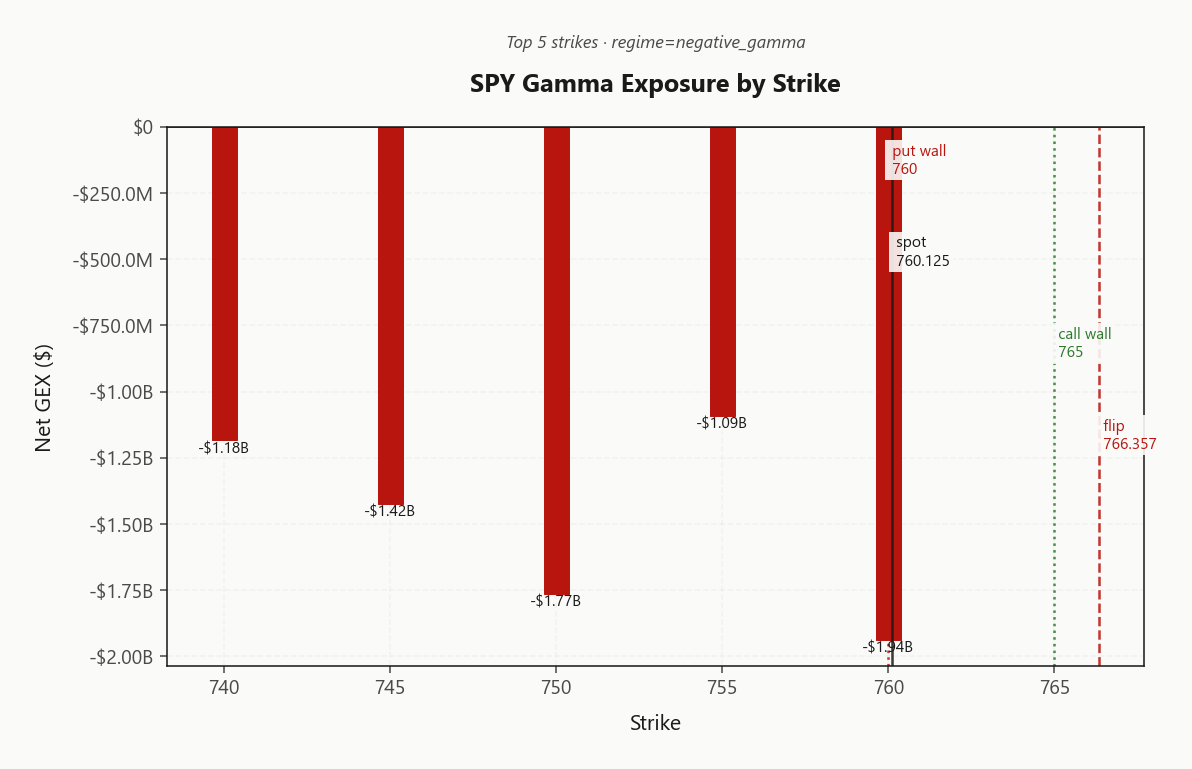
Open interest concentrates hard at 760.00, where dealers carry -$1.94B in short gamma - and spot is sitting directly inside that cluster. Flow stays reactive: every tick trades against a wall of hedging obligation, not through empty air. This is the microstructure that turns ordinary drift into amplified extension.
Gamma flip at 766.36 is the single level that matters. Below it, dealers sell weakness and buy strength in reverse - the amplification zone. A reclaim flips the book: hedging becomes stabilizing, and the tape shifts from momentum-friendly to mean-reverting. Watch that print at the level, not the level itself.
Highest all-in OI at 525 is a LEAPS anchor - deep, structural, and not a magnet for today's flow. The near-dated book runs between the 760.00 put wall and 765.00 call wall; that channel is where liquidity actually lives this session.
What it means for your trading
Spot at 760.00 sits inside the deepest dealer short-gamma cluster, so flow amplifies until 766.36 reclaims - that reclaim is the regime pivot, not a target.
Trading readConcentrated dealer short-gamma clusters right around spot at 760.00 - moves get amplified, not absorbed, until price clears gamma flip 766.36. Fade traders should stand aside below flip; momentum wins in negative gamma.Net dealer gamma exposure at each strike. Green bars = dealers long gamma (dampens moves toward the strike), red bars = short gamma (amplifies moves). Lines show spot, gamma flip (regime boundary), and the highest-gamma call/put strikes (walls).
Dealer Vanna & Charm
Second-order greeks stack against dealers: net vanna at -$94.49B and net charm at -$6.4M both print negative, so a vol tick drags dealer delta lower and time decay compounds the same lean into the bell. This is not a benign theta grind - it is a directional charm bleed layered on top of a short-gamma book.
The pivot sits at 760, tagged as a Put Wall zone with spot camped -0.0164446637 away. Bias reads Neutral - the flow inflection is armed, not yet triggered. A vol spike from here converts vanna hedging into forced selling; a quiet drift lets charm do the work into the close.
Trade the pivot, not the tape. Reclaim of 760 flips the flow signature toward supportive; loss of it and the vanna-charm stack becomes an accelerant rather than a headwind.
What it means for your trading
Vanna and charm both negative means dealers are wired to sell strength into vol and sell weakness into theta - the pivot at 760 is the single level that flips that wiring.
Cross-Asset Confirmation
MOVE sits at 83.71 - rates vol is contained, so this tape is an equity-vol story rather than a compounding credit shock. Without a bond-market bid for protection, the negative-gamma backdrop across index ETFs stays a positioning issue, not a systemic one.
Fear & Greed prints 29 in Fear territory while QQQ at 710.33 and IWM at 286.45 both carry the same negative_gamma label as SPY. Sentiment is defensive, positioning is uniform - a contrarian setup that historically resolves constructive on a 1-2 week horizon.
Cross-asset tone reads Aligned - the whole complex breathes together, with no rotation or macro divergence to lead the session. When SPY, QQQ, and IWM all sit below flip in unison, the macro VIX read matters more than any single index's flow; watch IWM first for fragility, since small-caps break the shared regime before mega-caps do.
What it means for your trading
MOVE at 83.71 keeps this an equity-vol event with Aligned cross-asset positioning - trade the index premium, not a credit tail.
Scenario EV
The scorecard lands on Iron Condor at 59, with the put spread trailing at 53 for anyone who needs directional lean. VRP prints 5.02% against HV20 8.69 - options are paying to sell, and VVIX at 94.72 keeps vol-of-vol Normal, so there's no jump-risk tax on sizing.
Sweet spot is 30-45 DTE - long enough for theta to matter, short enough to duck a regime shift into Elevated / Watchful. Wings outside the 765.00/760.00 channel, with 766.36 as the regime pivot to monitor.
Avoid naked short strangles: negative gamma at -$8.9B means a break of either wall extends rather than reverts, and undefined risk taxes an otherwise clean carry trade. Full-size the defined structures - Standard Size is the read.
What it means for your trading
Iron condor at 30-45 DTE is the highest-EV vehicle with VRP 5.02% rich and VVIX Normal. Keep it defined-risk - negative-gamma tape punishes naked strangles even when carry looks clean.
Actionable Summary
Bottom line: dealers are short gamma across the complex with SPY pinned at 760.00 and net GEX at -$8.9B - moves amplify below flip, not absorb. The setup rewards defined-risk premium sellers: Iron Condor at 30-45 DTE with wings outside the 765.00/760.00 channel, scoring 59 against put spreads at 53.
VRP at 5.02% with ATM IV 13.71% against HV20 8.69 pays the carry, and VVIX at 94.72 keeps vol-of-vol Normal - sizing guidance reads Standard Size, no jump-risk tax. VIX term structure holds Contango, so the vol-selling regime is intact within an Elevated / Watchful tape.
Watch two levels: gamma flip 766.36 - a reclaim flips dealer bias from selling weakness to buying strength - and the charm pivot at 760, today's intraday flow inflection. Avoid naked short puts while spot lives below flip; use spreads.
What it means for your trading
Iron condor at 30-45 DTE around the 765.00/760.00 channel is the highest-EV vehicle while dealers stay short gamma and VRP prints rich. Gamma flip 766.36 and charm pivot 760 are the regime pivots - a reclaim of flip flips the whole flow story.
Iran war fiscal cost signals a persistent macro overhang - matters for term-vol pricing more than intraday
Frequently Asked Questions
What is the current market volatility regime?
VIX is trading at 16.85 with a Contango term structure. The Fear & Greed index reads Fear, and cross-asset volatility is Aligned across SPY, QQQ, and IWM.
SPY's gamma flip is at 766.36 against a spot of 760.13. Above flip, dealer hedging is suppressive; below it, hedging amplifies moves.
Is implied volatility rich or cheap versus realized?
SPY's at-the-money implied vol is 13.71% with a volatility risk premium of 5.02%. Negative VRP means options are cheap relative to recent realized moves; positive VRP means insurance is expensive.
What does the VIX term structure say today?
The VIX curve is in Contango with VIX at 16.85. Contango signals benign forward expectations; backwardation signals near-term stress.
You're reading yesterday's market overview. Upgrade to Basic and get today's post-open analysis - the same data institutional desks use to set positioning each morning.
Unlock the full trading day
You see the market-open report. Growth gives you all 3 daily refreshes - midday regime shifts, close-wrap positioning, plus actionable trade ideas and "What it means for your trading" analysis.
What Basic includes
Today's market-open analysis
SPY, QQQ, IWM, VIX gamma regime
Key levels - flip, walls, max pain
VIX term structure + VRP analysis
Charts with trading reads
Full API access to lab.flashalpha.com
What Growth adds
3x daily refreshes (open, midday, close)
Actionable trade ideas per section
"What it means for your trading"
Regime shift alerts intraday
Close-wrap end-of-day positioning
Full archive history access
Plans start at $63/mo (billed yearly) · Cancel anytime