Help us double down on what's working, instead of guessing. Takes 5 seconds, totally optional.
Market Overview
Data-driven market structure analysis powered by lab.flashalpha.com - volatility, dealer positioning, and regime assessment across the index complex, refreshed multiple times per trading day. Every number is pulled straight from our API endpoints by deterministic code.
FlashAlpha ResearchAI-assisted
Generated
Validated citations - no literal numbers from LLM
You're reading yesterday's market analysis
Basic unlocks today's post-open analysis (9:45 ET).
Growth unlocks all 3 daily refreshes (open, midday, close) plus actionable trade ideas and “What it means for your trading”.
Growth unlocks the full trading day: midday (12:30 ET) + close wrap (4:15 ET), actionable trade ideas per section, and “What it means for your trading” analysis.
SPY at 765.07 sits fractionally below its gamma flip at 767.34, keeping dealers in Negative Gamma with net GEX of -$4.88B - every tick amplifies. Call wall at 770.00, put wall at 765.00, max pain at 752.00 - spot is glued to the pin. Dealer vanna at -$157.11B means a vol spike accelerates delta selling; charm at -$5.8M keeps them pressured into close. VIX at 15.47 with 9d/30d/3m at 14.39/15.48/19.06 - steep contango (7.57%%) and VRP at -1.26% give sellers carry, but negative VRP means options are cheap to recent realized. Bottom line: fade rips into 770.00, respect breakdowns below 765.00 - mean-reversion inside the walls, trend outside them. Iron condors 30-45 DTE preferred over naked strangles given Low VVIX regime.
Negative gamma across index complex with contango vol - dealer amplification below 767.34
The index complex sits in Negative Gamma with spot hugging the 765.00 put wall - dealer flows are amplifying, not dampening, intraday moves. Yet forward vol is priced calm (Steep contango - vol sellers favored) and VVIX contained at 86.86, giving vol sellers structural carry while charm/vanna pin the tape near the flip. The tension: microstructure is fragile, but the term curve says no imminent shock.
Dealer positioning levels
Symbol
Spot
Gamma flip
vs Flip
Call wall
Put wall
Max pain
Net GEX
Regime
SPY
765.07
767.34
-0.30%
770
765
752
-$4.88B
Short gamma
QQQ
711.39
713.26
-0.26%
715
710
700
-$2.98B
Short gamma
IWM
299.68
299.83
-0.05%
300
295
292
-$1.51B
Short gamma
VIX
15.47
15.53
-0.38%
20
15
17
-$19.19M
Short gamma
Spot below the gamma flip means dealers are short gamma and hedge with the move, which amplifies range. Above it they hedge against the move, which dampens it.
Volatility and risk premium
Symbol
ATM IV
HV 20d
VRP
25d skew
P/C OI
P/C volume
SPY
11.86
13.12
-1.26
1.94
2.56
1.70
QQQ
19.13
22.81
-3.68
2.12
1.22
1.55
IWM
15.88
15.53
+0.35
2.33
2.75
5.76
VIX
82.23
104.16
-21.93
-117.40
0.36
0.19
VRP is implied minus realised volatility. Positive means options are pricing more movement than has actually occurred, which favours sellers.
Volatility complex
Measure
Value
Change
VIX
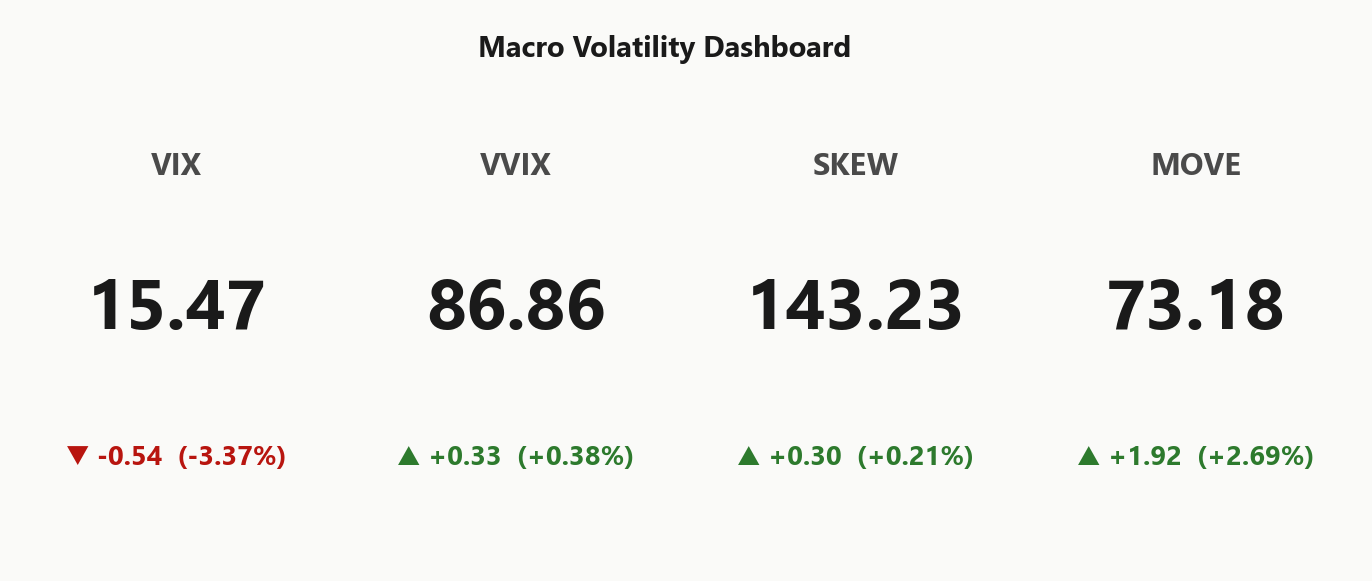
15.47
-3.37%
VVIX
86.86
+0.38%
SPX
7,670.36
+0.38%
SKEW index
143.23
+0.21%
MOVE (bond vol)
73.18
+2.69%
VIX term (9d/30d/3m/6m)
14.39 / 15.48 / 19.06 / 21.25
Steep contango
VVIX / VIX
5.61
Low
Regime
Elevated / Watchful
Regime Assessment
Current tape sits in a Elevated vol regime - Elevated / Watchful - with VIX at 15.47. The estimated half-life of 15 sessions is the operative fact: this is not a transient print, it is a state to plan around for weeks, not days. Positioning should be built with a theta window that matches the regime's stickiness, not the day's tape.
The transition matrix is asymmetric to the short-vol side. Probability of a drop to a low-vol regime over ten sessions sits at 0.45 against just 0.05 of a jump to panic in five - the modal path is quiescence, not escalation. Combined with steep contango and contained VVIX, the regime rewards patient premium sellers who respect the flip and the walls.
Bias: plan for elevated-but-fading vol; hold 30-45 DTE structures through their theta window, and treat any spike toward the upper VIX rail as a fade rather than a chase.
What it means for your trading
Regime is Elevated / Watchful and sticky - half-life of 15 sessions with the transition matrix skewed toward low-vol resolution (0.45) over panic (0.05). Structural setup favors 30-45 DTE short premium held to their theta window rather than tactical day trades.
Trading readVIX, VVIX, and SKEW are all confirming each other - no divergence, no hidden tail bid. MOVE elevated is the only dissenter, saying rates are the source of the vol regime, not equity fear.VIX = equity vol. VVIX = vol of vol (is the fear gauge itself being stressed?). SKEW = cost of tail hedges vs ATM. MOVE = bond vol. Divergences between them (e.g. calm VIX but elevated VVIX) often precede regime shifts.
Forward Vol Geometry
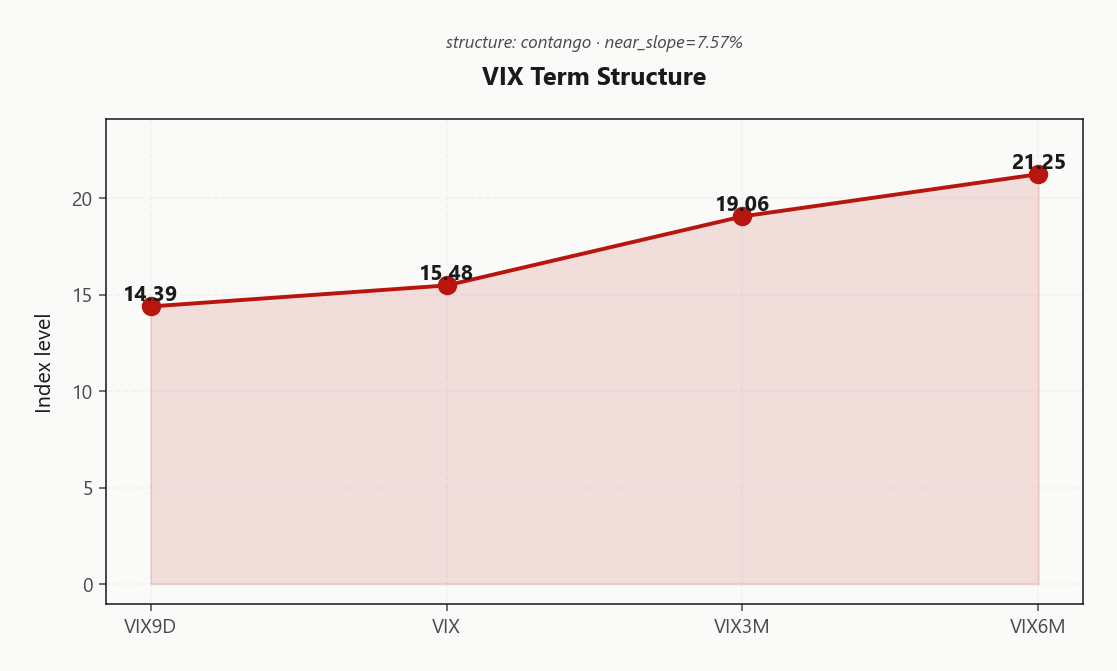
The VIX curve prints Contango with a near-slope of 7.57% - Steep contango - vol sellers favored. Front-week 14.39 trades at a discount to spot 15.47, telegraphing complacency in the immediate window while the 19.06 handle out at three months and 21.25 at six months keeps the back end structurally bid.
Roll-down carry is live for vol sellers, and critically no event premium is priced into the front - no binary is embedded in the near tenor. But the meat of the curve sits further out: forward 30-60 at 20.6182006974 and forward 60-90 at 23.234487298 imply the market is pricing mean-reversion higher in the vol regime, not lower. That's the calendar sweet spot - sell front, own back.
Regime read: Steep Contango. Trade it as carry, not as a directional vol call.
What it means for your trading
Steep contango into a discounted 14.39 front rewards short-vol carry, but the elevated back end at 21.25 flags that the market expects vol to normalize higher over quarters - favor calendars structured around forward 30-60 at 20.6182006974 over naked front-month shorts.
Trading readContango steep enough to reward short-vol carry, but not so steep it signals complacency - the 3m and 6m elevation says the market expects vol to normalize higher over quarters, not months.Forward VIX curve: VIX9D (9-day), VIX (30-day), VIX3M, VIX6M. Upward slope (contango) = calm regime + vol sellers favored. Downward (backwardation) = stress, vol buyers favored. Slope matters more than level.
Realized Vol Structure
SPY ATM IV printing 11.86% against HV20 of 13.12 and HV60 of 13.91 leaves VRP at -1.26% - options are trading below what the tape has actually delivered. That's an unusual combination inside a contango curve, and it says recent chop has out-earned what the market is willing to underwrite going forward.
QQQ is the deeper hole: VRP at -3.68% confirms tech has been the mover and options are chronically under-priced to realized. IWM is the outlier - VRP at 0.35% is the only genuinely positive carry across the index complex, meaning small-cap premium is the one place shorts are actually being paid for the risk they're wearing.
HV60 sitting above HV20 across the complex tells you realized is decelerating, not accelerating - the setup where short-premium 30-45 DTE captures the compression as spot vol grinds back toward implied. Structure the book around IWM as the paid leg and treat SPY/QQQ short vol as a nickel trade that only works if the tape genuinely slows.
What it means for your trading
Negative VRP inside contango is the market telling you options are cheap to what actually happened - short vol works only if realized keeps decelerating; IWM at 0.35% is the sole leg where carry is real.
Skew Convexity
SPY quarter-delta skew prints 1.94% with put wing at 9.13% against calls at 7.19% and ATM anchored at 7.66% - smile ratio 1.27%. Puts are bid but the curve is ordered, not convex-panicked. Translation: hedgers are engaged, dealers are not being force-fed tail. Put spreads finance themselves against this skew geometry - naked puts overpay for a wing that isn't blowing out.
IWM is the standout at 2.33% - small-cap left tail carries the concentrated hedging demand across the complex. That's the asymmetric downside vehicle: cheaper convexity per unit of beta than index puts, and the tape confirms IWM as the marginal risk canary. Meanwhile the call wing sits flat across SPY, QQQ, and IWM - no upside chase, no dealer squeeze risk on rallies, and no reason to reach for OTM calls when the skew won't reward the reach.
Net: sell the put-skew premium via defined-risk spreads, concentrate tail hedges in IWM, and let the dead call wing do the work on the short-call side of any condor.
What it means for your trading
Ordered put bid at 1.94% with dead calls means put spreads dominate naked puts and IWM at 2.33% is the cleanest downside hedge; no upside convexity to chase.
Vol-of-Vol Structure
VVIX at 86.86 against VIX at 15.47 prints a ratio of 5.61 - squarely in Low territory. The vol-of-vol tape is telling you the options market sees no bimodal tail, no jump risk lurking under the surface. When VVIX stays this contained relative to spot VIX, the distribution of forward vol outcomes is unimodal and mean-reverting - precisely the regime where short vol earns its keep without the fat-tail ambush.
Sizing guidance flows directly from the ratio: Standard Size. This is not the tape to half-size the book or hedge the hedges - the second-order vol surface is giving a green light. Confirmation comes from SKEW at 143.23, which shows no crash premium being paid into the tails. Puts are bid in an ordered fashion downstream, but the crash bid is absent upstream in the skew index itself.
Bottom line: benign vol-of-vol plus flat crash pricing equals the structural green light for defined-risk short premium. The environment rewards conviction on sizing, not defensiveness.
What it means for your trading
With VVIX/VIX at 5.61 and SKEW at 143.23, the vol surface is signaling no hidden binary - deploy short vol at Standard Size rather than shrinking the book.
Dispersion Spread
Dispersion is wide: SPY ATM at 11.86% versus QQQ at 19.13% - tech carrying nearly 2x the index vol print, with IWM in the middle at 15.88%. Single-name IV is outpacing index IV, which is the fingerprint of low realized correlation - the components are moving, the basket is not. That makes single-name premium expensive relative to what index hedges cost to carry.
The trade construction writes itself: sell single-name premium, hedge with index. Index puts and put spreads at 11.86% are the cheap leg of the correlation trade; naked QQQ short vol is the trap - you're short the very dispersion driving the complex. Prefer SPY/SPX as the short-vol vehicle where the index-vs-component spread is widest and correlation risk is best compensated.
Play the spread, not the level: sell name, buy index, or express it directly as an SPY-QQQ vol pair - long SPY vol, short QQQ vol - to isolate the correlation without carrying outright direction.
What it means for your trading
Dispersion between SPY at 11.86% and QQQ at 19.13% is wide enough to argue explicitly for selling single-name premium hedged with index, and against naked QQQ short vol. SPY/SPX is the preferred short-vol vehicle in this correlation regime.
Liquidity & Microstructure
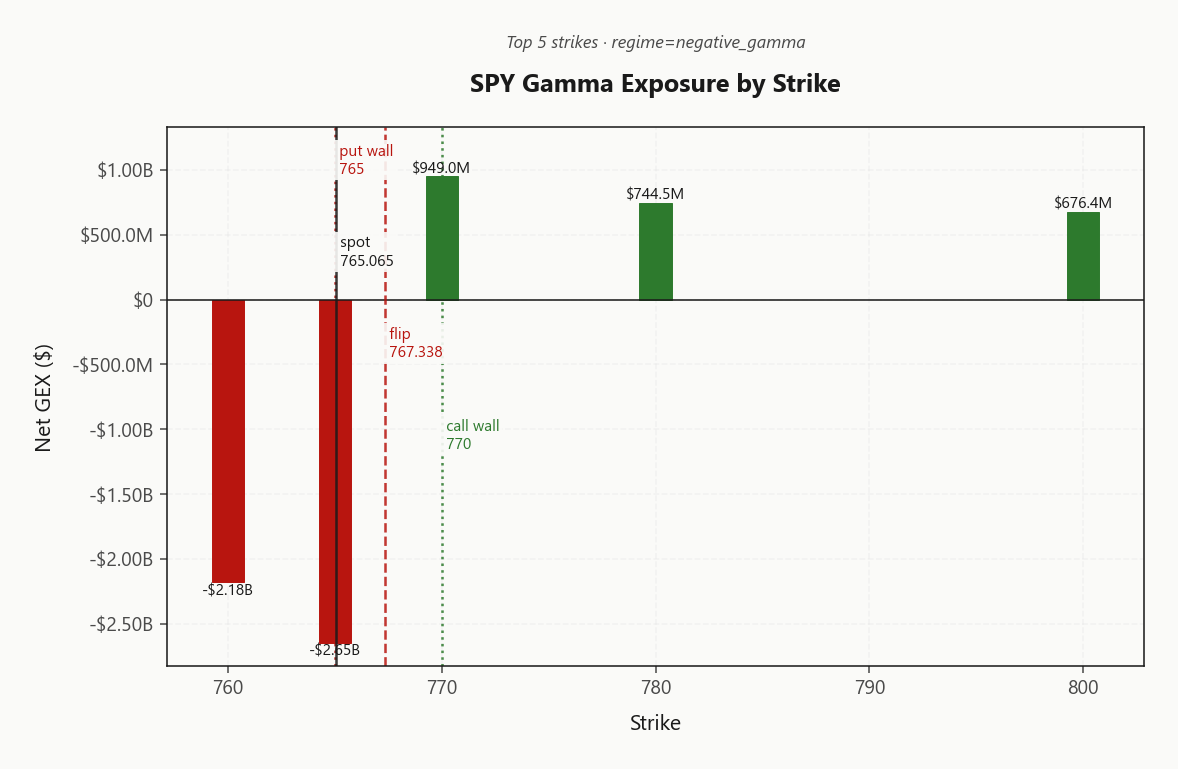
The book's center of gravity is the top strike at 765.00 carrying -$2.65B of net GEX - this is the magnet, not the legacy OI peak at 520. Spot at 765.07 is pinned fractionally below the gamma flip at 767.34, keeping dealers in Negative Gamma and their hedging pro-cyclical to every tick.
The line in the sand is 767.34: reclaim it and dealer buying underwrites rallies; lose it and amplification runs lower into the put wall at 765.00. That wall is the defended floor, the call wall at 770.00 the resistance ceiling - trade the range inside, respect the breaks outside.
OI-weighted DTE at 94 tells you this is medium-dated positioning, not scalp-driven 0DTE churn. Structural, not tactical - meaning the walls hold with weight behind them until real supply forces a re-rack.
What it means for your trading
Spot glued below the flip at 767.34 with the magnet strike at 765.00 - dealers amplify every move until the flip is reclaimed. Fade inside 765.00/770.00, respect breaks outside.
Trading readDealers are stacked negative around the put wall at 765.00 with the flip just overhead - any push above the flip flips dealer flow supportive, but every tick below deepens the amplification. Trade the walls, not the middle.Net dealer gamma exposure at each strike. Green bars = dealers long gamma (dampens moves toward the strike), red bars = short gamma (amplifies moves). Lines show spot, gamma flip (regime boundary), and the highest-gamma call/put strikes (walls).
Dealer Vanna & Charm
SPY dealer vanna sits at -$157.11B - deeply negative and the second-order risk of the session. A vol spike here forces the sell-side to sell delta as IV rises, an accelerant into any downside impulse rather than a stabilizer. This is the mechanism that turns an orderly drift into a cascade if VIX pops off the front-end floor.
Charm is running at -$5.8M, quietly pressuring dealers to lean shorter delta as theta bleeds through the session. With spot mapped against the Put Wall pivot at 765 and current bias Neutral, the path of least resistance is a slow drift lower into the bell unless the tape reclaims the pivot decisively.
The cross-asset offset: QQQ vanna prints $13.49B, opposite sign to SPY. Tech dealers get more stable if vol pops - a natural hedge against the SPY vanna accelerant and the reason pair structures screen better than outright index shorts today.
What it means for your trading
Vanna is the accelerant, charm is the drift - expect dealer flows to amplify any downside vol impulse into the close while QQQ's opposite-sign vanna provides the only structural buffer. Trade the pivot at 765 as the flip line for flow direction.
Cross-Asset Confirmation
MOVE at 73.18 sits elevated while Fear & Greed reads Neutral at 53 - the tell is that rates vol is doing the driving, not equity fear. When bond convexity is bid but the sentiment gauge refuses to break lower, the vol premium in SPX is a duration echo, not a risk-off cascade. Short-vol books can stay engaged; this is not the tape that punishes carry.
The cross-asset print is Aligned with tone Unknown - QQQ at 711.39 and IWM at 299.68 both sit in negative gamma alongside SPY, but the small-cap tape is the marginal signal to watch. IWM is the canary for risk appetite; a break there front-runs any credit-to-equity contagion the MOVE print might otherwise foreshadow.
No credit widening, no cross-asset panic bid, no divergence between index complexes - just an isolated equity/rates event with an aligned dealer book. Vol sellers keep the trade on, size the tail via IWM downside rather than SPY, and treat any MOVE decompression as the confirming green light.
What it means for your trading
MOVE elevated with F&G Neutral flags a rates-driven vol regime, not a fear spike - cross-asset tape reads Aligned with IWM at 299.68 as the small-cap canary. No credit contagion means short-vol carry stays viable.
Scenario EV
The book scores Iron Condor as the highest-conviction structure at 26, with the optimal window at 30-45 DTE. The logic: Low VVIX at 86.86 greenlights capped-risk short vol, while Contango at 7.57% steepness kills the calendar trade - the front is already discounted, there's no roll-down edge left to harvest.
Iron condors win the head-to-head over naked strangles because VRP is negative - SPY at -1.26%, QQQ deeper at -3.68% - meaning options aren't rich enough to justify unlimited tail risk. Bracket the wings at 765.00 and 770.00, sized Standard Size. The regime half-life at 15 sessions gives the structure room to breathe through its theta window without a forced exit.
What it means for your trading
Deploy Iron Condor at 30-45 DTE bracketing 765.00/770.00, Standard Size - the defined-risk structure is the only way to be paid short vol when VRP is negative and gamma is hostile.
Actionable Summary
Structure of the day: Iron Condor bracketing 765.00/770.00 in the 30-45 DTE window, standard sizing given Low VVIX at 86.86. The pivot is 765 (Put Wall) - flow direction inverts across it and current bias is Neutral. Regime reads Elevated / Watchful with a half-life of 15 sessions, so plan in weeks not days.
Avoid naked strangles - VRP is -1.26%, options aren't rich enough to justify unlimited risk. Skip long calls; call skew is flat and there is no dealer squeeze fuel. Steer clear of single-name short vol in tech where QQQ VRP prints -3.68%. Hedge of choice: SPY put spread over naked puts - skew is ordered, defined risk wins. Watch IWM as the small-cap canary and spot versus 765.
Regime exit trigger: VIX through 19.06 or SPY breakdown below 765.00 - either flips the book from range-trade to trend-hedge.
What it means for your trading
Trade the range inside 765.00/770.00 with Iron Condor structures, respect breakouts across 765, and let the 15-session regime half-life carry the theta.
Sets the tape narrative for the day - a higher open after a rate-driven pullback frames whether dealer amplification cuts with the rebound or against it.
Gold rebound plus weaker dollar and elevated yields is the classic macro cocktail that keeps MOVE bid - bleeds into equity vol premia and validates the elevated regime call.
Escalating Iran sanctions is the geopolitical risk overlay - oil complex volatility and any China cooperation angle can spill into risk assets fast, worth flagging to short-vol books.
Micron/memory sentiment shift is the semiconductor read-through that reinforces the dispersion story - single-name tech vol remains the driver, not the index.
Hyundai capacity expansion into Georgia is a marginal auto/manufacturing signal - matters for cyclicals and IWM tape given small-cap divergence is today's cross-asset tell.
Frequently Asked Questions
What is the current market volatility regime?
VIX is trading at 15.47 with a Contango term structure. The Fear & Greed index reads Neutral, and cross-asset volatility is Aligned across SPY, QQQ, and IWM.
SPY's gamma flip is at 767.34 against a spot of 765.07. Above flip, dealer hedging is suppressive; below it, hedging amplifies moves.
Is implied volatility rich or cheap versus realized?
SPY's at-the-money implied vol is 11.86% with a volatility risk premium of -1.26%. Negative VRP means options are cheap relative to recent realized moves; positive VRP means insurance is expensive.
What does the VIX term structure say today?
The VIX curve is in Contango with VIX at 15.47. Contango signals benign forward expectations; backwardation signals near-term stress.
You're reading yesterday's market overview. Upgrade to Basic and get today's post-open analysis - the same data institutional desks use to set positioning each morning.
Unlock the full trading day
You see the market-open report. Growth gives you all 3 daily refreshes - midday regime shifts, close-wrap positioning, plus actionable trade ideas and "What it means for your trading" analysis.
What Basic includes
Today's market-open analysis
SPY, QQQ, IWM, VIX gamma regime
Key levels - flip, walls, max pain
VIX term structure + VRP analysis
Charts with trading reads
Full API access to lab.flashalpha.com
What Growth adds
3x daily refreshes (open, midday, close)
Actionable trade ideas per section
"What it means for your trading"
Regime shift alerts intraday
Close-wrap end-of-day positioning
Full archive history access
Plans start at $63/mo (billed yearly) · Cancel anytime