Help us double down on what's working, instead of guessing. Takes 5 seconds, totally optional.
Market Overview
Data-driven market structure analysis powered by lab.flashalpha.com - volatility, dealer positioning, and regime assessment across the index complex, refreshed multiple times per trading day. Every number is pulled straight from our API endpoints by deterministic code.
FlashAlpha ResearchAI-assisted
Generated
Validated citations - no literal numbers from LLM
You're reading yesterday's market analysis
Basic unlocks today's post-open analysis (9:45 ET).
Growth unlocks all 3 daily refreshes (open, midday, close) plus actionable trade ideas and “What it means for your trading”.
Growth unlocks the full trading day: midday (12:30 ET) + close wrap (4:15 ET), actionable trade ideas per section, and “What it means for your trading” analysis.
SPY at 728.14 sits in Negative Gamma with net GEX at -$19.12B - dealers amplify moves, not dampen them. Call wall 750.00, put wall 725.00, gamma flip 745.92 - spot is sitting on the put wall, meaning any further drift lower unleashes dealer selling into weakness. Net VEX at $70.18B means a further vol spike forces dealers to sell delta - vanna is hostile here, not supportive. VIX at 20.23 up 11.09%, VVIX at 107.25 up 8.87% - vol-of-vol re-priced but term structure stayed in Contango with slope 3.38%, so the curve doesn't yet believe in sustained stress. VRP at 8.55% with IV richly paid over 20d RV of 9.95 - vol sellers still get carry, but only well outside the wings. Bottom line: Iron Condor in the 30-45 bucket around max pain 738.00 is the ranked edge - reject anything requiring spot to hold above 725 without confirmation.
Negative gamma across index complex with VIX popping to 20.23 - dealer amplification live
Fed held rates and the tape flushed - SPX shed -1.52% while VIX surged 11.09% into a negative-gamma dealer book. VVIX at 107.25 says the market is quietly bidding vol-of-vol even as term structure stays in contango. Spot is pinned right at the put wall - the charm pivot - where dealer flow flips from supportive to hostile.
Dealer positioning levels
Symbol
Spot
Gamma flip
vs Flip
Call wall
Put wall
Max pain
Net GEX
Regime
SPY
728.14
745.92
-2.38%
750
725
738
-$19.12B
Short gamma
QQQ
660.66
698.97
-5.48%
700
660
690
-$8.52B
Short gamma
IWM
287.95
296.01
-2.72%
300
285
289
-$4.97B
Short gamma
VIX
20.63
20.22
+2.01%
25
17
20
$49.03M
Long gamma
Spot below the gamma flip means dealers are short gamma and hedge with the move, which amplifies range. Above it they hedge against the move, which dampens it.
Volatility and risk premium
Symbol
ATM IV
HV 20d
VRP
25d skew
P/C OI
P/C volume
SPY
18.50
9.95
+8.55
1.23
2.00
1.26
QQQ
30.76
19.91
+10.85
1.19
1.28
0.95
IWM
23.23
11.79
+11.44
2.13
2.73
3.53
VIX
108.79
100.05
+8.74
-58.60
0.34
0.76
VRP is implied minus realised volatility. Positive means options are pricing more movement than has actually occurred, which favours sellers.
Volatility complex
Measure
Value
Change
VIX
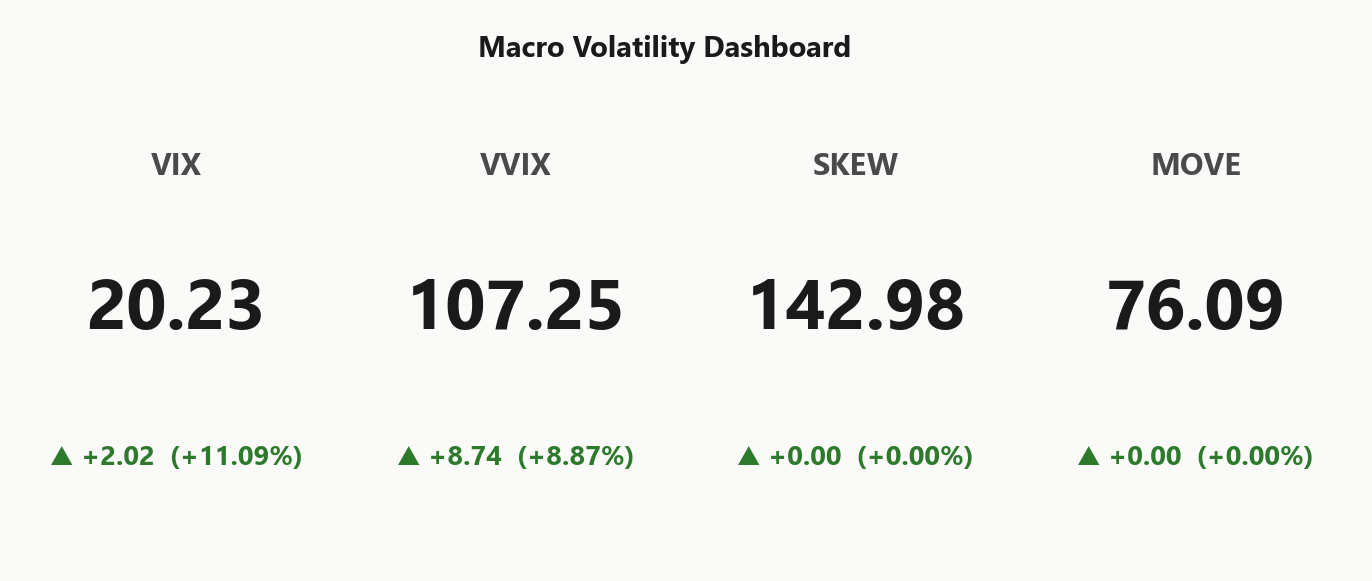
20.23
+11.09%
VVIX
107.25
+8.87%
SPX
7,316.15
-1.52%
SKEW index
142.98
0.00%
MOVE (bond vol)
76.09
0.00%
VIX term (9d/30d/3m/6m)
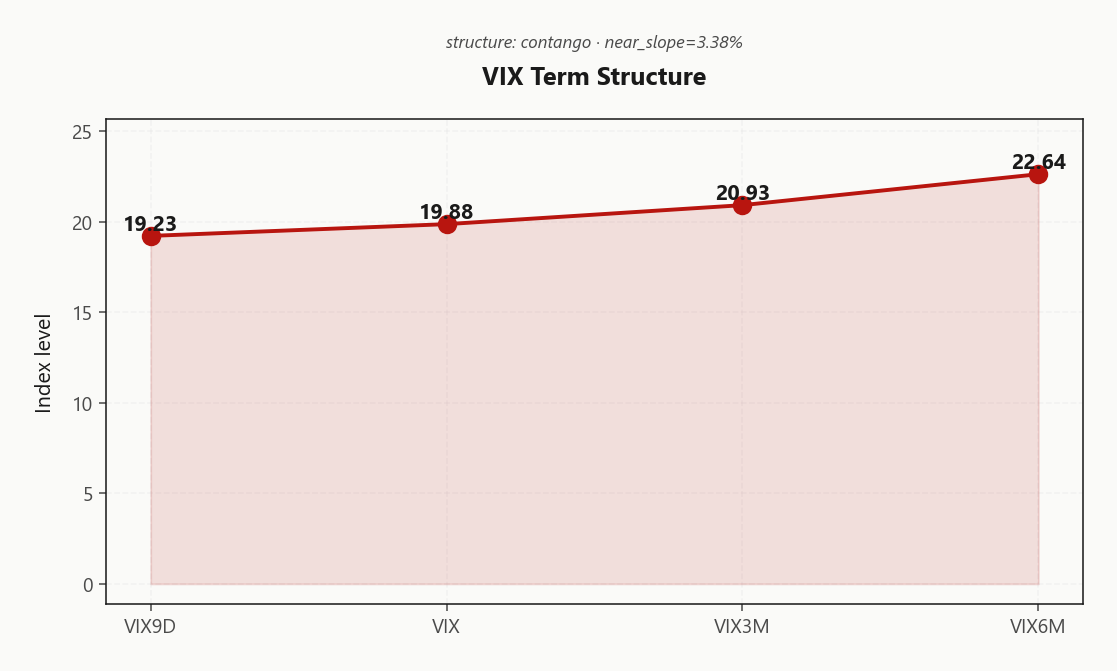
19.23 / 19.88 / 20.93 / 22.64
Contango
VVIX / VIX
5.30
Normal
Regime
Elevated / Watchful
Regime Assessment
Regime reads Elevated - Elevated / Watchful - with VIX parked at 20.23. Not a break, not a bore. This is the meaty middle where the tape has repriced enough to demand respect but not enough to force capitulation, and where directional bets carry the worst expectancy.
The transition math is the tell: probability of rolling to panic inside five sessions sits at 0.15, while probability of decaying back to a low-vol regime over ten sessions runs 0.45 - mean reversion is the base case, but the tail is live. Half-life of 15 sessions says this state is sticky at moderate horizons; do not underwrite a same-week normalization.
The vol-of-vol pop is the question the flat-vol print won't answer. Cross-asset tone reads Aligned - no rotation hide, the equity complex moves as one. Trade the range, size for the roll-to-panic tail, and let the half-life do the work.
What it means for your trading
Regime is Elevated / Watchful with mean-reversion favored (0.45 vs 0.15) but a 15-session half-life that punishes assumptions of quick normalization.
Trading readVIX and VVIX both jumped, SKEW stale, MOVE flat - bond vol is NOT confirming equity vol. That divergence usually means the equity move mean-reverts before the credit market catches up.VIX = equity vol. VVIX = vol of vol (is the fear gauge itself being stressed?). SKEW = cost of tail hedges vs ATM. MOVE = bond vol. Divergences between them (e.g. calm VIX but elevated VVIX) often precede regime shifts.
Forward Vol Geometry
The front end held Contango straight through the Fed print - VIX9D at 19.23 printed below spot VIX at 19.88, which is the curve refusing to price near-term panic even as the headline number popped. The belly and back - 20.93 at 3M and 22.64 at 6M - sustain a positive slope of 3.38%, keeping the carry regime fully intact.
Forward vol regime tags Contango - Contango - structural carry available. Read that literally: the curve is telling you this shock does not stick. The Fed reaction re-priced the front but the term structure never blinked, which is textbook sellable event vol rather than the front edge of a regime break.
The clean expression is short front-end premium financed by 30-45D long vol - capture the event decay, own the belly against a genuine deterioration. If VIX9D crosses above VIX and the curve inverts, the trade is off; until then, contango is the edge.
What it means for your trading
Front-end Contango holding through the VIX pop with slope 3.38% intact means the curve doesn't believe the shock - sell the front, own the belly, and treat any inversion of VIX9D over VIX as the kill signal.
Trading readContango held despite the VIX pop - the curve is telling you this shock doesn't stick. Vol carry trade lives, but front-end sellers should hedge with belly longs.Forward VIX curve: VIX9D (9-day), VIX (30-day), VIX3M, VIX6M. Upward slope (contango) = calm regime + vol sellers favored. Downward (backwardation) = stress, vol buyers favored. Slope matters more than level.
Realized Vol Structure
ATM IV at 18.5% is trading at a fat premium to 20-day realized of 9.95, and the 60-day print of 13.24 confirms RV was decelerating into the Fed - vol was bleeding out of the tape right up until the print. That leaves options structurally overpriced to the recent path, and the VRP at 8.55% is a real cushion for premium sellers rather than an accounting artifact.
The GEX-conditioned read Dealers short gamma - rich premium may reflect genuine tail risk. reinforces the setup: negative dealer gamma normally forces realized higher, but the shortfall to implied is wide enough to absorb a meaningful uptick before the sale breaks. Net harvest score 54 flags the regime as still tilted toward the seller, not the buyer.
The live risk is compression: today's tape can close the IV-RV gap fast if the negative-gamma amplification lets realized run into implied. Sell the premium, but hedge the wings - the cushion shrinks with every intraday range expansion.
What it means for your trading
IV at 18.5% sits rich to realized of 9.95 with VRP at 8.55% - premium sellers keep the edge, but a fast realized print today would compress the trade quickly.
Skew Convexity
Front-expiry 1.23% quarter-delta skew is only modestly steep against today's vol repricing - put wing at 24.46% versus ATM 24.93% shows hedgers paying up, but not the disorderly tail-bid you'd expect if the Fed print had genuinely broken sentiment. This was systematic-ish repositioning, not capitulation.
The call wing is the tell: 23.23% sits below ATM - desks are not paying for upside convexity, and the smile ratio at 1.05% reads balanced with a put lean rather than a two-sided panic. CBOE SKEW at 142.98 stays elevated, but that print is stale from prior session and hasn't yet ratified today's tape.
Structure: put spreads finance themselves at this skew geometry - sell the modestly-bid put wing against the steeper ATM to fund longer-dated protection, and skip naked puts where you'd be paying skew without collecting it back.
What it means for your trading
Skew at 1.23% with smile ratio 1.05% says hedgers repriced but did not panic - put spreads over naked puts is the funded expression while call-wing conviction is absent.
Vol-of-Vol Structure
VVIX at 107.25 popped 8.87% against VIX at 20.23 - a bigger move in ratio terms than headline vol itself. The VVIX/VIX ratio prints 5.30, classified Normal. Translation: the market is quietly bidding convex outcomes even while flat vol looks tame on the tape.
Sizing guidance reads Standard Size - respect the vol-of-vol pop, don't dismiss it because headline VIX is only a 20-handle. The kink matters: wing longs, backspreads, and other convex payoffs are getting cheaper relative to central vol as VVIX pushes higher without a corresponding VIX blowout.
The trade lens: don't stack naked short premium against a repricing VVIX. If you're selling the Iron Condor in the 30-45 bucket, buy the wings - the convexity is closer to fair than the ATM straddle suggests, and today's ratio move is the tell.
What it means for your trading
VVIX at 107.25 versus VIX at 20.23 - ratio 5.30, level Normal - says the tail is being re-priced faster than the body. Keep Standard Size and finance short premium with cheap wings rather than running naked.
Dispersion Spread
Cross-strike dispersion at 25.34 reads moderate - the vol repricing is tape-level, not a fan-out of idiosyncratic single-name premium. Cross-expiry dispersion at 1.78 confirms the shock is concentrated in the front, with the belly refusing to rerate. ATM IV at 18.5% is carrying the bulk of the premium load, meaning wings aren't paying up disproportionately - the surface widened at the center, not the tails.
That geometry pushes the cleaner sale to index-level structures rather than single-name vol. When correlation dominates on a Fed print - and the cross-asset regime tags Aligned across SPY, QQQ, IWM - the dispersion premium in single names compresses just as the index-level premium expands. Sell the index, not the constituents.
Structure the trade against the Iron Condor in the 30-45 bucket, wings pinned outside 750.00 and 725.00. SPY/SPX vehicles carry the correlation trade; single-name shorts add basis risk without incremental edge here.
What it means for your trading
Cross-strike dispersion at 25.34 is moderate and cross-expiry at 1.78 is tight - this is an index-correlation repricing, and index-level premium is the cleaner short than single-name vol.
Liquidity & Microstructure
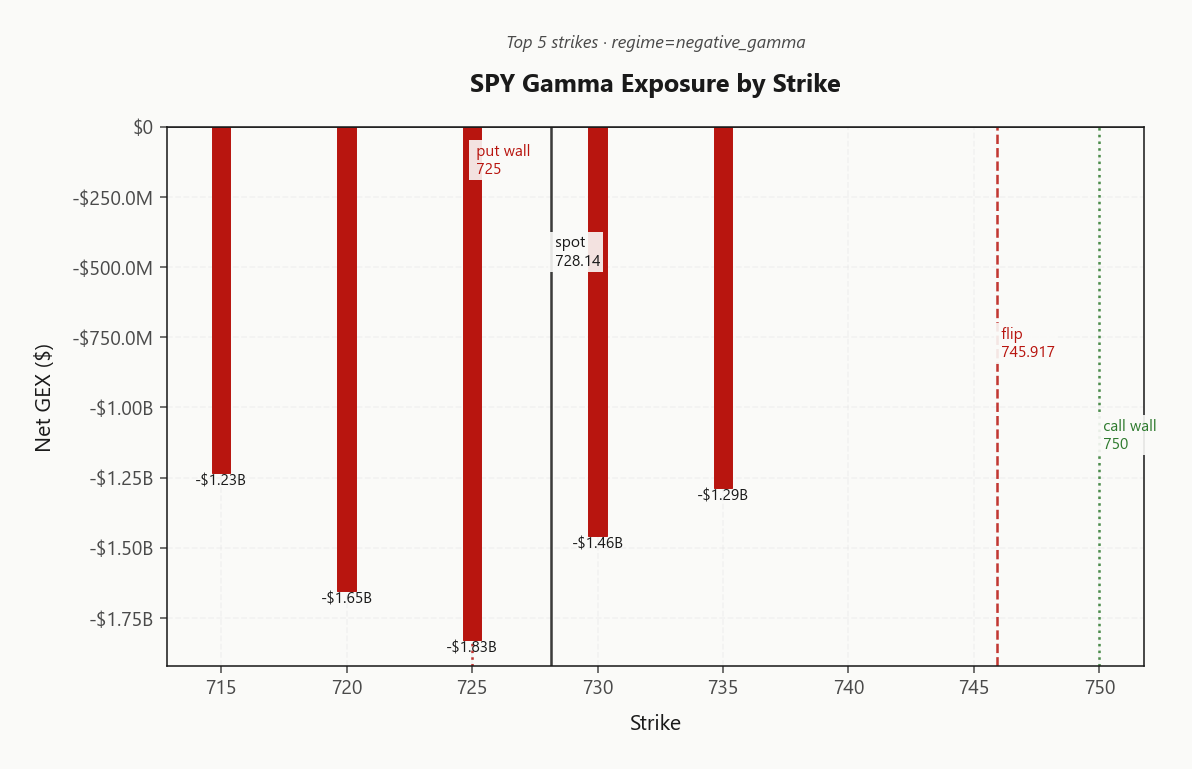
Spot 728.14 is pinned directly on the put wall at 725.00 - the trapdoor. With the gamma flip up at 745.92 and spot trading beneath it, dealers are unambiguously short gamma; the same hedge that stabilizes above the flip accelerates into weakness below the wall. The book is asymmetric by design.
The call wall at 750.00 caps any relief rally, while the heaviest negative-GEX brick stacks at 725.00 printing -$1.83B - that's the concentration point where dealer selling recruits itself on every downtick. The highest-OI strike at 550 is a stale magnet from a prior regime, not today's driver.
Max pain sits well north at 738.00, meaning the put book is working against dealer positioning rather than with it - no natural pin lower, and no theta tailwind to lean on. Reclaim 745.92 and the mechanics invert; lose 725.00 cleanly and the amplification is live.
What it means for your trading
Spot sitting on 725.00 beneath the gamma flip at 745.92 is the definition of a hostile microstructure - dealers stabilize above, accelerate below, with the negative-GEX cluster at 725.00 as the trapdoor.
Trading readThe negative-GEX bricks stack right at and below spot - this is the layout of a tape where every downtick recruits dealer selling. Above the call wall the picture reverses and dampens, so upside chase gets absorbed.Net dealer gamma exposure at each strike. Green bars = dealers long gamma (dampens moves toward the strike), red bars = short gamma (amplifies moves). Lines show spot, gamma flip (regime boundary), and the highest-gamma call/put strikes (walls).
Dealer Vanna & Charm
Net VEX at $70.18B paired with a Negative Gamma book is the setup traders keep misreading: vanna is an accelerant here, not a shock absorber. A further leg higher in vol forces dealers to sell delta into a tape that's already short gamma - Vol up = dealers buy delta - downside dampened if vol spikes is the mechanical read, and it flips hostile the moment VVIX at 107.25 extends.
Charm is the other missing crutch. Net CHEX prints at $36.5M - effectively flat - so there is no supportive theta buy-back building into the close to catch a drift. The pivot sits at 725, the Put Wall, with current bias Neutral and spot distance -0.4312357514. Above that line dealers stabilize; below, vanna and gamma compound in the same direction.
Trade the greek asymmetry: fade vol pops with defined-risk structures above 750.00, but refuse to hold naked short premium if spot loses 725 - that's where the accelerant lights.
What it means for your trading
With net VEX at $70.18B and CHEX at $36.5M, dealer greeks are aligned against a bounce - vanna sells delta on further vol, charm offers no natural buy-back, and the Put Wall at 725 is the trapdoor to respect.
Cross-Asset Confirmation
Rates vol is the tell today. MOVE at 76.09 is sitting flat while VIX ripped on the Fed print - the bond market is not confirming the equity shock. That's a signature pattern: when equity vol pops without a corresponding bid in rates vol, the move is almost always an equity-desk repricing rather than a credit or funding event bleeding through.
Sentiment agrees with the diagnosis. Fear & Greed reads Fear at 35 - cooling, not capitulating. And across the equity complex the regime is uniformly heavy: QQQ at 660.66 and IWM at 287.95 both sit in negative gamma alongside SPY, so there's no rotation trade to hide inside. Cross-asset tone reads Unknown with divergence direction Aligned - the complex moves as one.
Read: isolated equity vol pop with rates and credit refusing to co-sign. Mean-reversion odds are elevated once the Fed dust settles, and index premium is the cleaner sell than single-name convexity here.
What it means for your trading
MOVE flat against a VIX spike plus F&G at 35 says this is an equity-desk Fed reaction, not a credit event - with the complex Aligned in negative gamma, mean-reversion sits on the higher-probability side of the tape.
Scenario EV
Ranked edge is Iron Condor scoring 62 against the put spread's 55 - the condor wins because contango plus a moderate skew make the call wing an efficient short rather than a giveaway. Optimal duration sits in the 30-45 DTE band, far enough out to let vanna and charm decay work for you, close enough that theta actually pays.
Wing construction is mechanical: pin the short call above the 750.00 call wall where dealer flow dampens upside, and the short put below the 725.00 put wall where the trapdoor already lives. Iron condor score of 62 reflects a yellow-light setup - the structure is right, but the vol-of-vol pop demands respect.
Sizing: Standard Size given VVIX at 107.25. Headline VIX looks tame but convexity re-priced faster than central vol - do not upsize into a curve that's quietly bidding tails.
What it means for your trading
Sell the Iron Condor in the 30-45 bucket with wings outside 750.00 and 725.00, sized at Standard Size - the condor's edge is real but the vol-of-vol jump caps the clip.
Actionable Summary
Preferred structure:Iron Condor in the 30-45 DTE bucket - short call above 750.00, short put below 725.00. Contango holding at VIX 20.23 with VVIX 107.25 means the vol-of-vol pop is sellable, not a regime break. Size Standard Size - respect the convexity re-pricing even as headline vol reads modest.
Avoid holding naked short vol or unhedged short puts if spot cracks below 725 - that's the trapdoor where dealer flow accelerates the tape rather than absorbing it. Vanna is hostile here, charm offers no tailwind into the close.
Watch: gamma flip 745.92 for regime re-entry, VIX 20.23 for follow-through, VVIX 107.25 for convex re-pricing. Regime reads Elevated / Watchful - half-life 15 sessions says plan the trade, don't marry it.
What it means for your trading
Sell the vol-of-vol pop with Iron Condor in 30-45 DTE, but the moment spot loses 725 the structure is no longer defensible - that's the trapdoor, not a level to fade.
The Fed hold is the entire tape today - MSFT and META AI capex prints tomorrow inherit an already-repricing vol surface and a short-gamma dealer book, so any surprise gets amplified.
Drone hit on an Egyptian Mediterranean gas tanker keeps the Middle East risk premium sticky under the surface - matters for the crude/vol correlation and any overnight tape gap.
Fresh US Iran-related sanctions on tankers and insurers ratchet the geopolitical premium in oil and shipping - supports MOVE staying bid and keeps event-vol overlays justified.
Houthis considering Red Sea transit fees is a slow-burn shipping/inflation input - not a same-day driver but shapes the term-structure of macro tail hedges.
Iran ruling out regional Hormuz management removes a de-escalation vector - keeps the geopolitical vol floor elevated even if headlines quiet down.
Frequently Asked Questions
What is the current market volatility regime?
VIX is trading at 20.63 with a Contango term structure. The Fear & Greed index reads Fear, and cross-asset volatility is Aligned across SPY, QQQ, and IWM.
SPY's gamma flip is at 745.92 against a spot of 728.14. Above flip, dealer hedging is suppressive; below it, hedging amplifies moves.
Is implied volatility rich or cheap versus realized?
SPY's at-the-money implied vol is 18.5% with a volatility risk premium of 8.55%. Negative VRP means options are cheap relative to recent realized moves; positive VRP means insurance is expensive.
What does the VIX term structure say today?
The VIX curve is in Contango with VIX at 20.23. Contango signals benign forward expectations; backwardation signals near-term stress.
You're reading yesterday's market overview. Upgrade to Basic and get today's post-open analysis - the same data institutional desks use to set positioning each morning.
Unlock the full trading day
You see the market-open report. Growth gives you all 3 daily refreshes - midday regime shifts, close-wrap positioning, plus actionable trade ideas and "What it means for your trading" analysis.
What Basic includes
Today's market-open analysis
SPY, QQQ, IWM, VIX gamma regime
Key levels - flip, walls, max pain
VIX term structure + VRP analysis
Charts with trading reads
Full API access to lab.flashalpha.com
What Growth adds
3x daily refreshes (open, midday, close)
Actionable trade ideas per section
"What it means for your trading"
Regime shift alerts intraday
Close-wrap end-of-day positioning
Full archive history access
Plans start at $63/mo (billed yearly) · Cancel anytime