Help us double down on what's working, instead of guessing. Takes 5 seconds, totally optional.
Market Overview
Data-driven market structure analysis powered by lab.flashalpha.com - volatility, dealer positioning, and regime assessment across the index complex, refreshed multiple times per trading day. Every number is pulled straight from our API endpoints by deterministic code.
FlashAlpha ResearchAI-assisted
Generated
Validated citations - no literal numbers from LLM
You're reading yesterday's market analysis
Basic unlocks today's post-open analysis (9:45 ET).
Growth unlocks all 3 daily refreshes (open, midday, close) plus actionable trade ideas and “What it means for your trading”.
Growth unlocks the full trading day: midday (12:30 ET) + close wrap (4:15 ET), actionable trade ideas per section, and “What it means for your trading” analysis.
SPY at 739.46 sits below its gamma flip of 747.74 with net GEX at -$16.35B - dealers are short gamma and will amplify directional moves, not dampen them. Key levels: call wall 750.00 caps upside, put wall 735.00 is the downside magnet, and max pain 740.00 sits right at spot. Dealer positioning shows negative net DEX at -$22.17B with vanna at $19.63B - vol-up mechanically forces dealer delta buying, so a VIX spike is self-dampening from here. Vol read: VIX at 19.01 popped 14.24%% but term structure still contango (Contango) with VIX3M at 20.94, and VRP at 4.79% keeps premium selling alive. VVIX at 102.64 shows vol-of-vol firming but still Normal - standard size acceptable. Zero-DTE gamma is 22.2%% of total, meaningful but not dominant. QQQ and IWM both echo negative gamma - the regime is aligned across the complex, not a rotation story. Bottom line: Iron Condor at 30-45 DTE is the highest-scoring structure; fade rips into 750.00, buy dips only if spot reclaims 747.74, and avoid naked short vol until VVIX cools.
Negative gamma across index complex with VIX pop to 19.01; dealers amplify moves below 747.74
SPY trades below its gamma flip at 747.74 with dealers short gamma across the index complex - moves get amplified, not dampened, until spot reclaims the flip. VIX pop to 19.01 with VVIX at 102.64 confirms vol-of-vol is waking up, but term structure holds contango and VRP remains rich enough to fund defined-risk premium selling. Bias neutral-to-defensive: fade extremes into the walls, avoid naked short vol, respect the flip as the pivot for dealer flow direction.
Dealer positioning levels
Symbol
Spot
Gamma flip
vs Flip
Call wall
Put wall
Max pain
Net GEX
Regime
SPY
739.46
747.74
-1.11%
750
735
740
-$16.35B
Short gamma
QQQ
694.36
708.25
-1.96%
700
690
700
-$7.53B
Short gamma
IWM
291.86
296.19
-1.46%
300
290
290
-$3.01B
Short gamma
VIX
19.01
19.01
+0.00%
25
17
21
$10.09M
Long gamma
Spot below the gamma flip means dealers are short gamma and hedge with the move, which amplifies range. Above it they hedge against the move, which dampens it.
Volatility and risk premium
Symbol
ATM IV
HV 20d
VRP
25d skew
P/C OI
P/C volume
SPY
16.41
11.62
+4.79
2.83
1.90
1.79
QQQ
27.49
23.59
+3.90
4.78
1.39
2.02
IWM
21.48
11.63
+9.85
3.31
2.57
7.24
VIX
92.01
113.47
-21.46
-68.86
0.34
0.70
VRP is implied minus realised volatility. Positive means options are pricing more movement than has actually occurred, which favours sellers.
Volatility complex
Measure
Value
Change
VIX
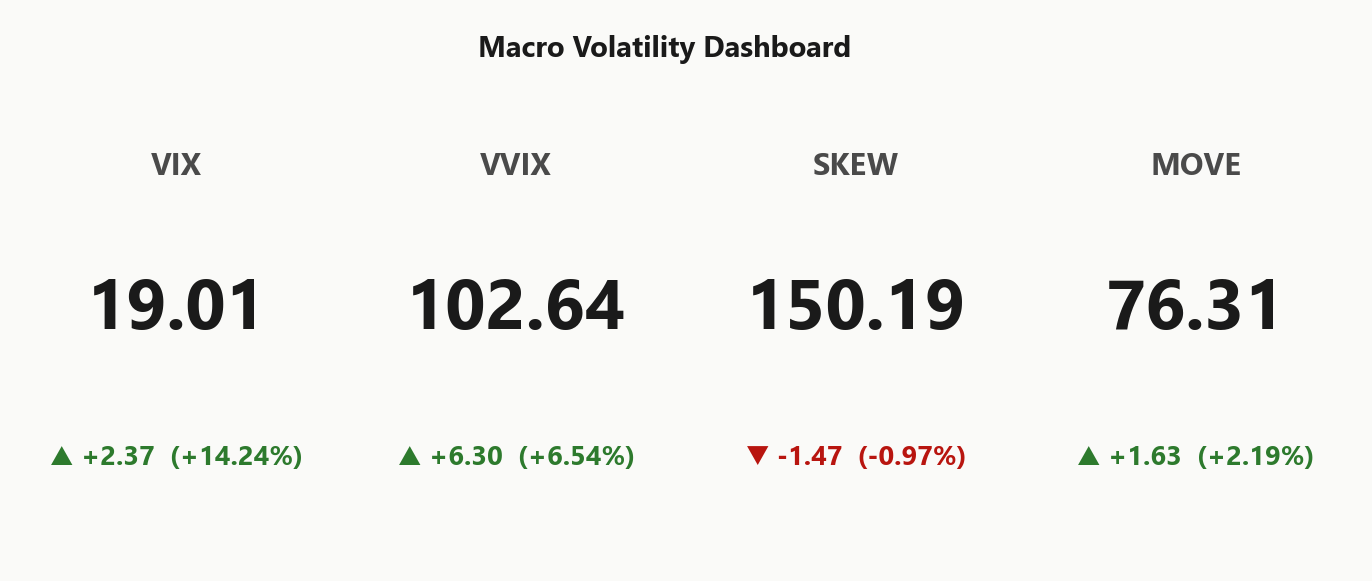
19.01
+14.24%
VVIX
102.64
+6.54%
SPX
7,418.32
-1.08%
SKEW index
150.19
-0.97%
MOVE (bond vol)
76.31
+2.19%
VIX term (9d/30d/3m/6m)
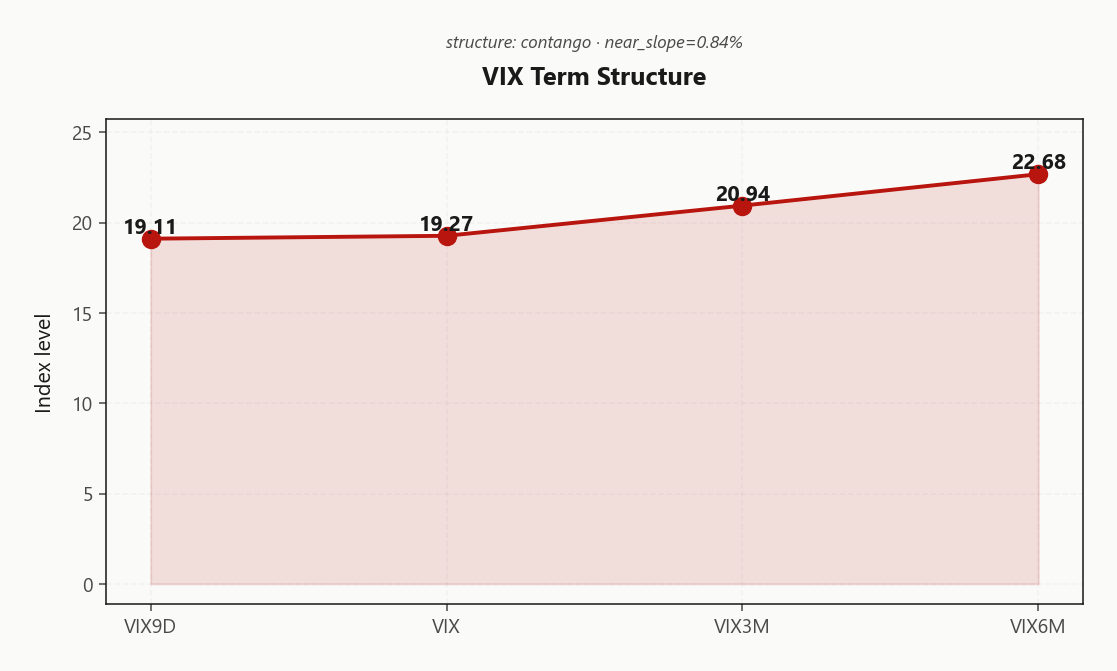
19.11 / 19.27 / 20.94 / 22.68
Contango
VVIX / VIX
5.40
Normal
Regime
Elevated / Watchful
Regime Assessment
Regime tags Elevated / Watchful with VIX parked at 19.01 - elevated enough to respect, not yet stressed enough to hedge aggressively. Half-life prints 15 sessions, which is the number that matters: this state is sticky, tradeable, and long enough to warrant structural positioning rather than tactical scalps.
Transition math favors drift back to calm over escalation. Probability of migrating to panic over the next week sits at 0.05, while the drift-to-low probability across ten sessions runs 0.45 - roughly an order of magnitude larger. That asymmetry is the trade: fade vol spikes, harvest carry, avoid paying up for tails the market isn't pricing.
Bottom line: Elevated and sticky is the working frame. Size normal, run defined-risk short vol at the belly of the curve, and only escalate hedges if VVIX and half-life both compress together.
What it means for your trading
Regime is Elevated / Watchful - sticky at 15-session half-life with panic odds of 0.05 versus drift-to-low odds of 0.45. Trade the mean-reversion, not the tail.
Trading readVIX pops with VVIX confirming but SKEW and MOVE staying calm - the vol move is equity-specific, not a broad risk-off cascade. Divergence between equity vol and rates/tail vol signals the shock is contained.VIX = equity vol. VVIX = vol of vol (is the fear gauge itself being stressed?). SKEW = cost of tail hedges vs ATM. MOVE = bond vol. Divergences between them (e.g. calm VIX but elevated VVIX) often precede regime shifts.
Forward Vol Geometry
The VIX complex prints clean ascending Contango across the curve: VIX9D at 19.11 anchors the front, spot VIX at 19.27, VIX3M at 20.94, and VIX6M at 22.68. The front-end pop is intraday noise, not a curve inversion - the market is pricing structural carry, not event stress.
Forward 30-to-60 sits at 21.7269176369, showing where the middle-of-curve carry lives. The regime is tagged Contango - structural carry available, and the slope premium fattens meaningfully in the belly. Best geometry-native edge lives in the 30-45 DTE window, where the roll-down is most productive and the front-end noise has time to decay.
Trade the slope, not the spot. Calendars financed against firmer back-end vol and defined-risk premium structures in the belly are the paid geometry; naked front-end short vol on the pop is where curve inversions ambush you if the noise turns into signal.
What it means for your trading
Ascending Contango intact from 19.11 through 22.68 - sell the belly at 30-45 DTE where forward vol prints 21.7269176369. Front-end spike is noise until the curve inverts.
Trading readContango slope of 0.84%% front-to-3M keeps the vol carry trade alive - the market isn't pricing stress it's pricing noise; short-vol carry structures remain viable at defined risk.Forward VIX curve: VIX9D (9-day), VIX (30-day), VIX3M, VIX6M. Upward slope (contango) = calm regime + vol sellers favored. Downward (backwardation) = stress, vol buyers favored. Slope matters more than level.
Realized Vol Structure
SPY realized is decelerating while implieds hold firm: HV20 at 11.62 undercuts ATM IV at 16.41%, and the longer window HV60 at 13.22 confirms tape volatility is cooling, not accelerating. That gap prints a SPY VRP of 4.79% - options are demonstrably rich to what the underlying is actually delivering.
Across the complex, the harvest sits in small-caps: IWM VRP at 9.85% runs meaningfully fatter than SPY, with QQQ VRP at 3.9% the thinnest of the three. Rank the premium-sell edge IWM > SPY > QQQ. This is a vol-seller's tape, but only in defined-risk form - negative gamma below the flip means naked short vol still gets amplified on any impulse move, and the VRP cushion doesn't compensate for open-ended tail.
What it means for your trading
Realized is cooling into rich implieds - SPY VRP 4.79% and a fatter IWM VRP 9.85% keep defined-risk premium selling live, with iron condors and put spreads preferred over naked short vol.
Skew Convexity
Front-week put wing bids at 19.48% against a call wing of 16.65%, printing a quarter-delta skew of 2.83% - steep, but ordered. The smile ratio at 1.17% tells the story: left tail is being paid up, right tail is soft. This is hedging demand, not panic bidding.
With ATM sitting at 17.57% and VRP still rich, structuring downside as put spreads finances the wing far cheaper than owning naked puts - you're selling the bid-up put back to the market while retaining defined convexity. Soft call skew confirms zero upside conviction; no one is chasing rips, which caps the payoff on outright calls and favors call-spread expressions if you must be long delta.
Cross-index, IWM skew at 3.31% runs hotter than SPY - small-cap tail is priced more urgently, sharpening the case for SPY put-spread hedges over IWM outrights. Fade the wing, don't buy it.
What it means for your trading
Skew is steep-but-ordered at 2.83% with the put wing bid over calls - express downside as put spreads to sell the rich wing back, and avoid naked longs on either side given soft call skew and rich ATM.
Vol-of-Vol Structure
VVIX prints 102.64 - up 6.54% on the session - with VIX at 19.01. Vol-of-vol is confirming the front-end pop, not front-running it. The VVIX/VIX ratio sits at 5.40, squarely in the Normal band - no bimodal or binary risk being priced into the wing of the wing.
That distinction matters for structure. When vol-of-vol leads, convexity gets expensive and short-vol carry becomes a tail-risk trade regardless of headline VRP. Here it lags - the surface is repricing spot risk, not repricing the distribution of vol itself. Sizing guidance: Standard Size. Iron condor and put-spread structures at the recommended DTE remain viable at book-standard notional; no need to cut clips.
What we don't add here is convexity risk - long-vega calendars stretching past the belly, or short-gamma positions that require VVIX to compress to pay. Until vol-of-vol either extends into stress territory or cools materially, treat this as a normal-regime vol tape with a firmer front-end bid, not a convexity event.
What it means for your trading
VVIX at 102.64 confirms the VIX pop but the ratio 5.40 sits in the Normal band - Standard Size on defined-risk premium selling, no added convexity exposure.
Dispersion Spread
The index vol stack shows classic dispersion asymmetry: QQQ ATM IV prints 27.49% against SPY at 16.41%, a spread that reveals single-name concentration in the Nasdaq mega-caps is dragging index IV higher than diversification math justifies. This is a component-driven bid, not a broad-market vol expansion - SPY VRP at 4.79% stays disciplined against realized even with dealers Negative Gamma.
IWM at 21.48% runs richer than SPY on a different axis - small-cap idiosyncratic risk plus thinner underlying liquidity - with VRP at 9.85% fattest in the complex. Cross-index correlation stays elevated with regime tone Aligned, so SPY hedges still track QQQ and IWM drawdowns; no rotation shelter to hide behind today.
Trade the geometry: sell SPY vol over QQQ, sell index over single-names, and lean on IWM premium if you can swallow the liquidity haircut. Frame condors outside 750.00 / 735.00 and let dispersion pay the carry.
What it means for your trading
QQQ IV at 27.49% is bloated by Nasdaq single-name concentration versus SPY at 16.41% - harvest index premium, not component premium, and let IWM's fatter VRP at 9.85% do the heavy lifting where liquidity allows.
Liquidity & Microstructure
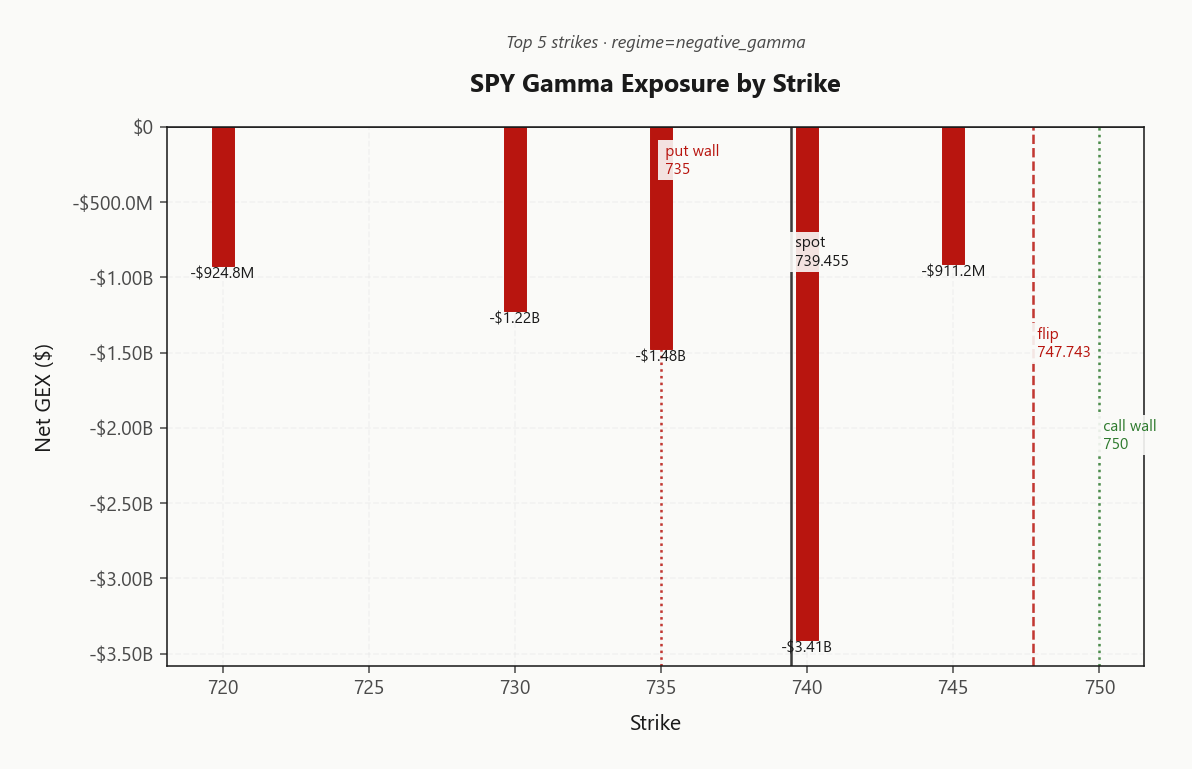
The book anchors at 740.00 with 318761 contracts stacked there and net gamma exposure sitting at -$3.41B - this is the trapdoor. With spot printing below the gamma flip at 747.74, dealer hedging amplifies directional flow rather than absorbing it; the mechanical bid stays offline until price reclaims the pivot.
The put wall at 735.00 is the downside magnet - the level where short-gamma selling meets pinned protective inventory and momentum typically exhausts. The call wall at 750.00 caps any relief rally with fresh dealer supply into strength. The highest-OI strike at 550 sits far from spot as pure LEAPS ballast - irrelevant to this week's tape. The live corridor is 735.00 to 750.00, with 747.74 as the regime switch.
Reclaim the flip and dealer flow reverts to dampening; until then, treat the walls as trade boundaries and respect the amplifier below.
What it means for your trading
Below 747.74 dealers amplify - fade rips into 750.00, expect exhaustion into 735.00, and treat 740.00 as the trapdoor pivot for regime direction.
Trading readWith SPY below the flip at 747.74, dealer hedging amplifies any move toward the put wall at 735.00 - that's the trapdoor level. Rallies into the call wall at 750.00 get faded by dealer supply.Net dealer gamma exposure at each strike. Green bars = dealers long gamma (dampens moves toward the strike), red bars = short gamma (amplifies moves). Lines show spot, gamma flip (regime boundary), and the highest-gamma call/put strikes (walls).
Dealer Vanna & Charm
Dealer vanna reads net-positive at $19.63B - a mechanical cushion sitting under the tape. Any VIX pop from here forces dealer delta buying against the vol move, partially offsetting the amplifier effect of negative gamma below the flip. That asymmetry is the trade: gamma feeds the trapdoor into 735.00, but vanna quietly bids the belly if fear does the work.
Charm is muted at $3.1M - no coherent theta-driven pin, no mechanical drift into the bell. End-of-day flow will follow spot, not the clock; don't lean on a stale close-of-day grind that isn't in the greeks.
Pivot type is Max Pain at 740, dealer bias tagged Neutral. Reclaim the shelf and vanna support compounds with the regime flip back to dampening; lose it and gamma dominates the print with no charm buffer to slow the tape.
What it means for your trading
Positive net VEX at $19.63B makes vol-up self-dampening while flat charm removes any end-of-day drift crutch - trade the Max Pain pivot at 740, not the clock.
Cross-Asset Confirmation
MOVE at 76.31 stays contained while equity vol pops - this is an equity-specific event, not a credit or rates shock bleeding across the stack. Bond vol calm alongside a VIX bid tells you the tail is not compounding; the shock is ring-fenced to the index complex, and the cross-asset transmission channel that usually turns a vol pop into a drawdown is quiet.
Fear & Greed reads Fear at 41 - leaning defensive but nowhere near the panic threshold that flags contrarian longs. QQQ at 694.36 and IWM at 291.86 both sit in negative gamma alongside SPY: the regime is Aligned across the complex, so there is no rotation shelter and no divergence trade. Cross-asset tone reads Unknown.
Playbook: treat this as a contained equity vol event, not the front edge of a broader risk-off cascade. Fade wing extremes, keep defined-risk premium sellers on, and only escalate hedges if MOVE breaks its range or F&G cracks toward extreme fear.
What it means for your trading
Bond vol at 76.31 stays calm while the equity complex trades aligned negative gamma - the shock is contained to stocks, not compounding across assets, which keeps defined-risk premium selling viable rather than forcing a full defensive pivot.
Scenario EV
The scoreboard prints Iron Condor at 58 - the highest-scoring structure on the book and the textbook response to rich VRP, Normal vol-of-vol, and an intact Contango term structure. VRP assessment reads Unknown on the tape but the underlying math is unambiguous: HV20 at 11.62 versus ATM IV at 16.41% is the harvest signal, and IWM sits fatter still at 9.85% for size-tolerant books.
DTE sweet spot is 30-45 - far enough out to fund theta against the negative-gamma amplifier, close enough to compound VRP decay. Frame the wings outside750.00 and 735.00; those are the dealer walls doing structural work, not arbitrary strikes. Standard size given VVIX at 102.64 - no need to trim, no license to press.
The trade discipline: fade rips into 750.00, respect the flip at 747.74 as the pivot between amplification and dampening, and refuse naked short vol until VVIX cools. Defined risk or nothing.
What it means for your trading
Iron condor scoring 58 at 30-45 DTE is the trade: sell wings outside 750.00 / 735.00, standard size, defined risk only while spot sits below 747.74.
Actionable Summary
BLUF: sell the wings, respect the flip, size normal. With regime tagged Elevated / Watchful and dealers pinned short gamma below 747.74, the highest-scoring structure is Iron Condor in the 30-45 DTE window - VRP is rich, VVIX at 102.64 reads Normal, and contango holds at Contango. Frame wings outside the 750.00 call wall and 735.00 put wall; standard size, no naked short vol.
Pivot sits at 740 - the Max Pain level where dealer flow direction inverts. Bias stays Neutral until spot reclaims 747.74, at which point the regime flips from amplifier to dampener and short-vol structures compound. Fade rips into 750.00; do not chase below 735.00. Cross-index is Aligned - no rotation shelter.
What it means for your trading
Iron condor at 30-45 DTE is the trade, framed outside 750.00/735.00 with standard sizing; the reclaim of 747.74 is the single tell that flips dealer flow back to supportive.
China snapping up Russian and Iranian crude as Mideast risk rises - the persistent oil bid is why VIX contango still holds despite equity weakness; energy is the pressure valve.
Lockheed lifting 2026 forecasts on Pentagon restocking - defense capex cycle is real, not headline-driven; supports one of the few rotation-into-strength trades.
Moonshot AI reportedly accessed banned Nvidia chips via Thailand - regulatory risk overhang on NVDA even as its GEX shift ranks #1 today; watch for policy response.
American Airlines cuts 2026 outlook on fuel costs - margin compression from oil is spreading; airline weakness confirms energy-cost regime is biting cyclicals.
Trump vows Iran retaliation with oil over $100 - geopolitical tail is live; this is why the skew wing still bids and vol-of-vol firmed.
Frequently Asked Questions
What is the current market volatility regime?
VIX is trading at 19.01 with a Contango term structure. The Fear & Greed index reads Fear, and cross-asset volatility is Aligned across SPY, QQQ, and IWM.
SPY's gamma flip is at 747.74 against a spot of 739.46. Above flip, dealer hedging is suppressive; below it, hedging amplifies moves.
Is implied volatility rich or cheap versus realized?
SPY's at-the-money implied vol is 16.41% with a volatility risk premium of 4.79%. Negative VRP means options are cheap relative to recent realized moves; positive VRP means insurance is expensive.
What does the VIX term structure say today?
The VIX curve is in Contango with VIX at 19.01. Contango signals benign forward expectations; backwardation signals near-term stress.
You're reading yesterday's market overview. Upgrade to Basic and get today's post-open analysis - the same data institutional desks use to set positioning each morning.
Unlock the full trading day
You see the market-open report. Growth gives you all 3 daily refreshes - midday regime shifts, close-wrap positioning, plus actionable trade ideas and "What it means for your trading" analysis.
What Basic includes
Today's market-open analysis
SPY, QQQ, IWM, VIX gamma regime
Key levels - flip, walls, max pain
VIX term structure + VRP analysis
Charts with trading reads
Full API access to lab.flashalpha.com
What Growth adds
3x daily refreshes (open, midday, close)
Actionable trade ideas per section
"What it means for your trading"
Regime shift alerts intraday
Close-wrap end-of-day positioning
Full archive history access
Plans start at $63/mo (billed yearly) · Cancel anytime