
FlashAlpha System Architecture
A detailed breakdown of our low-latency compute cluster, from OPRA ingestion to SignalR delivery.
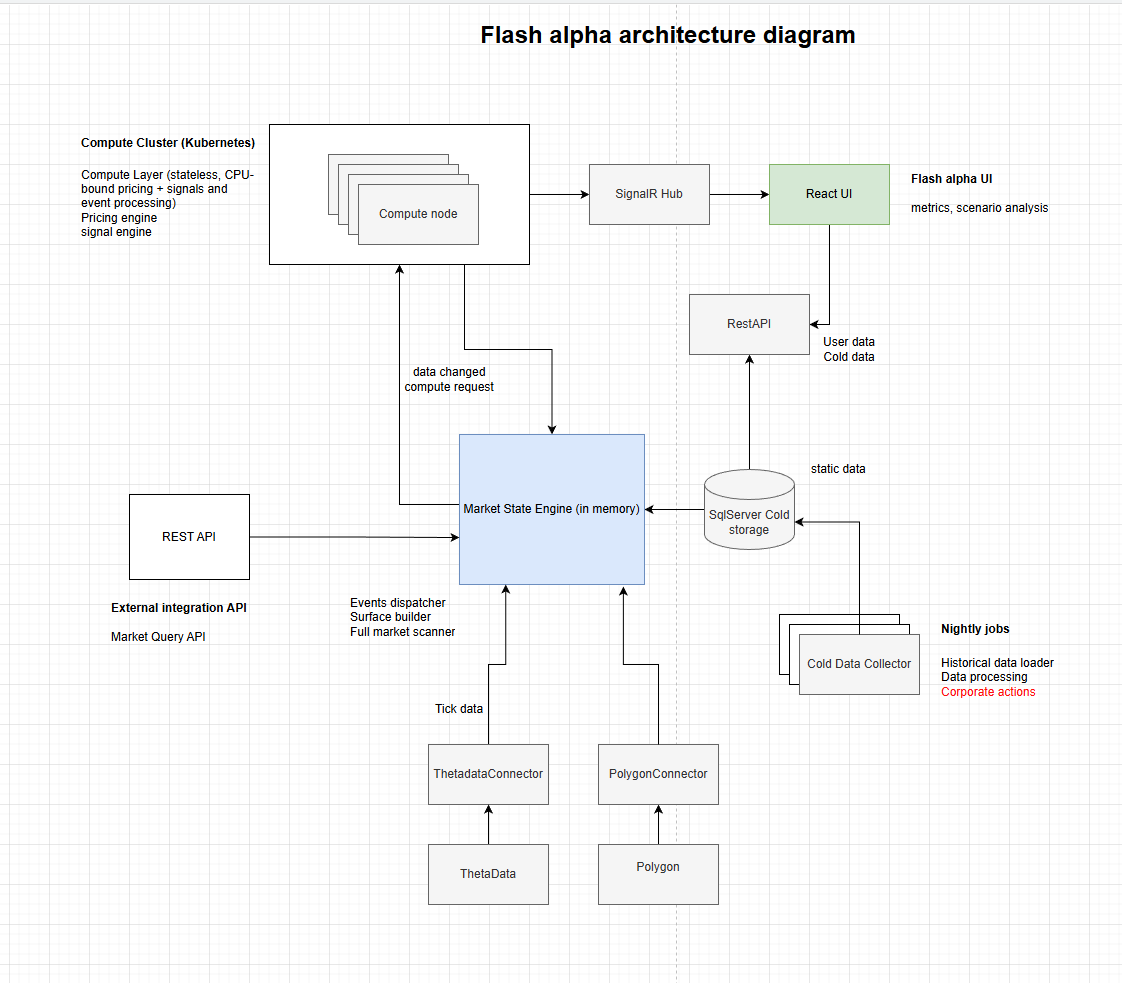
1. Ingestion Layer (ThetaData / Polygon)
FlashAlpha ingests raw market data from multiple providers to ensure redundancy. We utilize ThetaData and Polygon for real-time tick and consolidated quote feeds.
- ThetaDataConnector & PolygonConnector: Specialized services that handle raw socket connections, managing heartbeat logic and reconnection strategies.
- Tick Data Normalization: Incoming packets are normalized into a standard internal format before being passed to the engine.
2. The Market State Engine (In-Memory)
At the core of the platform is the Market State Engine. This is a monolithic, high-performance in-memory state manager.
- Zero-Copy Processing: designed to minimize GC pressure by using struct-based layouts and unmanaged memory where necessary.
- State Management: Maintains the "live" state of the entire option market (over 1.8M instruments potentially).
- Events Dispatcher: Routes changes (price updates, volume spikes) to the appropriate sub-systems (Surface Builder, Scanner).
3. Compute Cluster (Kubernetes)
Heavy computational tasks are offloaded to a scalable Kubernetes cluster.
- Stateless Compute Nodes: These nodes handle CPU-bound signals, pricing models (Black-Scholes, Binomial), and event processing.
- Horizontal Scaling: As market activity increases (e.g., market open), K8s spawns additional compute pods to handle the load.
4. Data Storage (Hot & Cold)
We employ a tiered storage strategy:
- In-Memory (Hot): The Market State Engine holds live data for immediate query and display.
- SQL Server (Cold): All trade data, aggregated metrics, and historical snapshots are persisted to SQL Server for post-day analysis and cold retrieval.
- Cold Data Contractors: Nightly jobs that run historical data loading and handle Corporate Actions processing to keep reference data pristine.
5. User Interface & API
Delivery to the client must be as fast as the backend.
- SignalR Hub: Pushes real-time updates to connected clients using WebSockets. This avoids polling and reduces latency for the end-user.
- React UI: A modern, responsive frontend that renders complex volatility surfaces and metrics grids efficiently.
- REST API: Provides programmatic access to user data and "cold" historical data.
Ready to trade on this infrastructure?
Stop building it yourself. Start finding alpha.